 SOUNDTRACK: MOUNT KIMBIE-Tiny Desk Concert #121 (April 18, 2011).
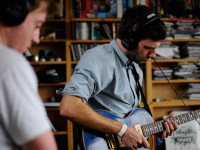 After subscribing to the NPR Podcasts, I found out that every few days, a new concert gets downloaded to my folder (which is pretty cool, but which I must check on from time to time so I don’t fill my machine!).
This Tiny Desk concert came along unannounced by a band I’d never heard of. I’m not planning to listen to every concert that comes along, but this band seemed interesting. Mount Kimbie’s Crooks and Lovers made the NPR list of “Albums We Missed in 2010” and the song they play there “Before I Move Off” is a fun and twisted song of blips and bleeps set to a catchy beat. About mid way, the samples (cut up and unrecognizable) come in and add a new (almost creepy) texture to this song.
This concert reveals the less “programmed” side of the band as there is an electric guitar and (evidently from the notes) a live drum. What’s most interesting about these songs is that even after a few minutes of riff and repeat, they throw something in that changes things. Like the vocals (!) on “Maybes” (which frankly don’t live up to the rest of the song) that begin in the last-minute of a 5 minute song. (The opening noises are really great).
The other two tracks “Ode to Bear” and “Field” are good, interesting electronic tracks. But after a couple of listens to the show, I was actually growing a little bored with them. It wa s good introduction, but that’s probably as far as it will go for me and Mount Kimbie.
[READ: April 6, 2011] “Two Fables”
A fable is defined as “a short story to teach a moral lesson.” Given this definition, I would say that these stories failed as fables. I didn’t get any kind of moral lesson from either of them. Indeed, I have a hard time with a lot of things that claim to be modern fables if only because of the definition…a vague or missing moral seems to me that it fails as a fable.
Anyhow, these two “fables” are short (half a page each). The first, “A Divided Man” made more sense to me than the other one. In it, a hard-working man in Bosnia suffers his wife’s death. After her death, he throws himself into his work, but he also begins going out at night, staying up late, and enjoying himself. He grows afraid that he may run into his hard-working self leaving for work when he comes home after staying out all night. And so he does. The rest of the piece is about the two sides of himself fighting each other.
The second “fable,” “A Crow” was less satisfying. Most of the references to the crow came from the main character’s (animal) family wiping crow shit from his lapel. It seems to be about a man (crow?) who has died. But I honestly couldn’t get much more out of it.
Not my cup of tea.

 I Just Read About That...
We’ve been filming one short live action fable a month. Seems many people have left their imagination and connection to universal metaphors behind in the world of instant information and 30 second attention spans. Read the definition of fable again… they don’t have to contain a moral. They come from the world we cannot see or touch and attempt to manifest it this wasteland. Take away what you can, but any criticism is irrelevant here.
Hi Ellen. I’m really looking forward to watching your films! I revisited the definition; true, definitions two and three do not say anything about a moral. I’m always curious about secondary and tertiary definitions and how they play against the primary one. So if it accepted that we do not need a moral, I guess these two stories work better. As I’m looking for a better word than fable (legend, tall tale) nothing really works. Perhaps fable is the most likely. I still think that a moral is implicit though. I’m not entirely sure what to take away from your last sentence, but I do look forward to your shorts. These fables were still not my cup of tea.