 SOUNDTRACK: TEENAGE FANCLUB-Shadows (2010).
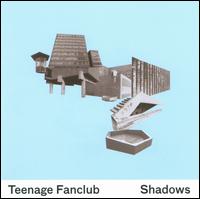
Back in the 90s, Teenage Fanclub released a few noisy, feedbacky records that were quintessential 90s alt rock.
Since then they have mellowed considerably, and this album is one of their most mellow to date. Usually for me this kind of mellowing is a sign that I’m done with a band; however, Teenage Fanclub’s songwriting gets better with every disc. And these folky tracks are all fantastic.
What’s neat about the arrangement of the album is that each of the three members of the band writes four songs. They are collated so that you cycle through each singer before repeating. You get maximum diversity–and it’s easy to tell which songwriter is your favorite.
The opening two songs, “Sometimes I Don’t Need to Believe in Anything” and “Baby Lee” are two wonderful upbeat pop confections. They sound very different and yet both are infused with wonderful pop chops.
It seems that Blake is my favorite songwriter on this disc. He did “Baby Lee”, “Dark Clouds” (a pretty piano based number) and by far the prettiest song on the disc “When I Still Have Thee.” It’s an amazingly catchy folk song that sounds timeless (and even has the great couplet: “The Rolling Stones wrote a song for me/It’s a minor song in a major key.”
That’s not to dismiss the other songwriters at all. In fact, hearing their different takes on pop music is really pretty amazing. It’s a shame that it takes them so long to put albums out (about 5 years these days).
[READ: June 10, 2011] Five Dials Number 9
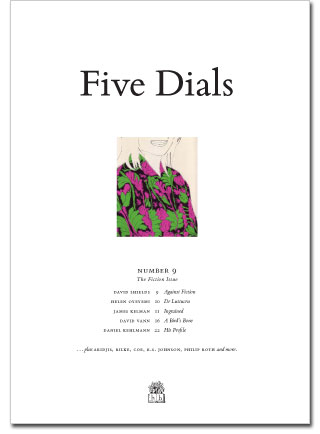
Five Dials Number 8, The Paris Issue, was pretty big (45 pages), but it had a lot of pictures. Five Dials Number 9 is also pretty big (41 pages) and it’s (almost) all text. For this is the Fiction Issue, and there are a lot of short stories in here.
CRAIG TAYLOR-A Letter from the Editor: On ‘Summer Reading’ and Fiction Issues.
Since most of what I talk about in the introduction to these posts is covered in Taylor’s Letter from the Editor, I figured I’d switch formats and start talking about his letter right away. In this letter, Taylor talks about the serious pitfalls of ‘Summer Reading’: We pledge to read mammoth books over the summer, but really we never finish War and Peace over the summer, do we? (except those of us who finished Infinite Summer, am I right?). And so, this Fiction Issue was released in December (finally, a date is given to a Five Dials!). Taylor briefly talks about all of the authors who contributed (including a pat on the back to Five Dials for securing the rights to a Philip Roth contribution in its first year of publication). He also talks about the essay from David Shields that is decidedly anti-fiction. And the final note is that Taylor’s own father has a piece in this issue (nepotism is alive and well!)
CLARE TAYLOR-A Single Book: The Sorrow of War by Bao Ninh
Taylor’s essay is all about being in Vietnam and witnessing a woman wandering around selling books from a stack she ‘s carrying on her hip. For indeed, it appears that many women made their livelihood selling knockoffs of popular novels to tourists–he notices Graham Greene’s The Quiet American and Bao Ninh’s The Sorrow of War. Taylor watches as the woman moves from restaurant to restaurant trying to get someone to buy a book (she has a permanent bruise on her hip from carrying so many). Most people turn her away, but occasionally someone sees a good deal (an £8.99 UK book for $10 US–half off!). Taylor then reveals that the books are primarily photocopied (covers and all) in a shop–but they look very close to the real thing. It’s a fascinating look at another culture.
DARIAN LEADER-Currentish Events: The British Government v. Psychoanalysis
This article looks at the (then) currentish event of the British Government trying to impose very strict regulations on how psychoanalysis is done (451 rules in all). Some of the rules are quite sensible (and are actually in place by the British Psychoanalytic association), but others are very strict and very specific and are quite damaging to the institution of psychoanalysis. For the best analysts often perform unconventional therapies to achieve breakthrough. The new rules are all designed to ease government payouts (like with every other medicine). Leader makes a very convincing case for why this seemingly commonsense series of regulations is actually bad practice.
SIMON PROSSER & DANIEL PEMBERTON-The List: All the DJ’s on Brick Lane
This amusing little piece attempts to decipher all of the DJ fliers that they found around their Five Dials offices when they briefly moved to an office near a popular club. After explaining how their names can show what kind of music they will play, the authors provide a list of the 180 or so DJs who have played there.
DAVID SHIELDS-Against Fiction
Shields writes that he no longer wishes to write fiction. Instead, he wishes to write in lyric essay form. He proceeds to tell us 6 reasons why the lyrics essay is superior to fiction. I see some validity in some his arguments–his argument about memoir is right on: “memoir rightly belongs to the imaginative world, and once writers and readers make their peace with this fact, there will be less argument over the ethical question about the memoir’s relation to the ‘facts’ and ‘truth.'” But overall he seems to be arguing that he just doesn’t have a good imagination. While the statement: “the lyric essay is the literary form that gives the writer the best opportunity for rigorous investigation,” seems reasonable and true, his criticisms of the novel are not reasonable at all:
I can never remember characters’ names, plot developments, lines of dialogue, details of setting. It’s not clear to me what such narratives are supposedly revealing about the human condition…. I like work that’s focused page by page, line by line, on what the writer really cares about rather than hoping that what the writer cares about will somehow mysterious creep through the cracks of narrative, which is the way I experiences most stories and novels.
To me that just sounds like he’s reading bad novels, or that he can’t be bothered to do any actual work while reading the book.
Shields ends with this resoundingly depressing paragraph:
Life is in large part, rubbish. The beauty of ‘reality-based art–is that it’s perfectly situated between life itself and (unattainable) ‘life as art.’
I happily disagree.
HELEN OYEYEMI-Dr Lustucru
This half a page story was quite surreal. In it, a doctor cuts off his wife’s head thinking he could replace it whenever he wished her talk. So one day he does, but then she won’t stop talking, in fact she won’t stop saying the same thing over and over again. She eventually runs away and the doctor realizes that he wronged his wife. The ending is suitably funny/surreal.
JAMES KELMAN-Ingrained
This is a kind of stream of consciousness story that I admit I got a little lost in. In it, Kelman’s narrator thinks about what a shithole he lives in and wonders how on earth any children could grow up there. Despite my getting lost, it was a very detailed story, so even if I missed some details, the overall picture was very vivid.
SHANE JONES-Six
Another peculiar piece, but far more surreal. In this one “everyone wears the number three on their shirts.” The whole story is about the one dissident who wants a six, but is only given threes.
DAVID VANN-A Bird’s Bone
This story was very satisfying. Despite its brevity it has two real parts to it. In the first we learn about the narrator’s family. His father recently died, but no one seems to know exactly how. There is a lot of flashback in this early section, with the narrator thinking about different family members. When it returns to the present we see that they are waiting to scatter his father’s ashes. But the will stipulates that they be scattered from a plane over his old hunting ground. The end of the story follows the narrator and his mother as they go on this mission. It was quite engaging.
CHLOE ARIDJIS-In the Arms of Morpheus
This is another wonderful story and may be the first one I’ve read about insomnia. It has an introduction which seems unrelated to the rest of the story, but which I thought was really interesting. The story opens with a discussion of how her local health food shop is right next to the London Hell’s Angels headquarters. And that all parties seem to get along pretty well. This is pretty much unrelated to the heart of the story in which she finds a flier for a clinic that offers to study insomniacs. The rest of the story shows her dealing with the clinic.
There’s lots of details and it’s really quite interesting. But aside from the clinical aspects of the story, she is more fascinated by the other “patient” in the clinic. And after her complimentary sleep study, the story takes a strange turn, most of which is in the narrator’s head.
DANIEL KEHLMANN-His Profile (translated by Anna Kelly)
This was a wonderful story in which an author is meant to be the subject of an upcoming cover story for a magazine. Nervous in general, he grows even more so when the reporter that is assigned to him starts asking a lot of questions. In fact, the questions grow more and more detailed and more and more outlandish (at one point a 9 page list of questions is sent by email). The questions begin to get very personal and more than a little presumptuous. And eventually he begins to define himself by the details in these questions.
PHILIP LANGESKOV-“Notes on a Love Story”
I do love a story with footnotes. This whole story is just under a page in length. But there are three full pages of footnotes. What makes the notes especially interesting is that they explicate the information behind the story. So you get the sense that while the story is fiction, the notes are reality. And so, the notes tell about what happened to the author to make him write the story. The story itself is a nice piece about two people in love, but the notes show how much pain underlies all of the good feelings. It’s a cool conceit.
JONATHAN COE-An Introduction…to B.S. Johnson
Coe loves B.S. Johnson, who I admit I’ve never read before. He makes Johnson sound interesting and exciting, playing with fascinating postmodern tricks while telling stories about his life….
B.S. JOHNSON-What Did You Say the Name of This Place Was?
Which is why I was so disappointed by this piece. I really wanted to like it. I even imagined which of his books I would want to read first (the one with the cut out in the page so you could see future events!). But this “travelogue” about Bournemouth was just kind of dull. Johnson plays with some different voices, and all, but I just never got into the story. Coe says that if we like this piece we should check out his other stuff. I wonder if the obverse is true.
LEONTIA FLYNN-Poem: “There’s Birds in My Story’
I enjoyed this poem.
HOW TO WRITE A LETTER: Rainer Maria Rilke to Kappau
After being away for many issues, this feature is back! Rilke writes an impassioned letter to Kappau (whoever or whatever that is).
ALAIN DE BOTTON-The Agony Uncle
Glad to have De Botton back as well. This advice column deals with the question of how much one should strive to “achieve” in one’s life. Does one really need to have done something “great” to be a great person. De Botton cites Christianity primarily to give the answer, no everyone is indeed equal in the eyes of God. The problem is that most societies value private gain.
He speaks of communities where the public realm (the realm of everyone) is strong and vibrant and designed to be enjoyed for all (in Switzerland where the public transportation is so nice and so welcoming that you don’t even want to own a car). This is of course not true everywhere, and so we rely on Christianity to make the ordinary seem less repellent.
CHRISTOPHER GIBBS-Remembrance: A Merlin-like Magus
This is a beautiful eulogy of John Mitchell (who I do not know). One can only hope to have a eulogy as wonderfully written about yourself some day.
There were four items called An Interruption included amidst the stories.
Writer v. Critic #1: The 1909 Paris Pistol Duel
In which M. Chevasu wrote a scathing review of M. Henry Bernstein’s play. Bernstein challenged him to a duel. One shot was fired, no one was injured.
Writer v. Critic #2: Burroughs v. Morris
Wright Morris called Naked Lunch “a haemorrhage of the imagination.” Would Burroughs take it as a compliment? If you know Burroughs, the answer may surprise you.
Writer v. Critic #3: Ford v. Hoffman
Alice Hoffman criticized Ford’s Independence Day, so in retaliation, he shot a hole in her latest book and mailed it to her. Ha!
Writer v. Critic #4: Philip Roth
The other Interruptions were all a paragraph or so. This one is several pages. It is a letter that Philip Roth wrote in 1969 to critic Diana Trilling (but which he never sent). His introduction states how cathartic it is to write such a letter but how there are five reasons not to actually send it:
- Writing (or imagining writing) the letter is sufficiently cathartic: by 4 or 5 A.M. the dispute has usually been settled to the novelist’s satisfaction and he can turn over and get a few hours’ sleep.
- It is unlikely that the critic is about to have his reading corrected by the novelist anyway.
- One does not wish to appear piqued in the least – let alone to be seething –neither to the critic nor to the public that follows these duels when they are conducted out in the open for all to see.
- Where is it engraved in stone that a novelist shall feel himself to be“understood” any better than anyone else does?
- The advice of friends and loved ones:“For God’s sake, forget it.”
In this letter, Roth addresses Trilling’s review of Portnoy’s Complaint in Harper’s. Roth defends himself and completely obliterates the idea that the Philip Roth in the book is indeed himself. It’s quite a lengthy rebuttal (and is a bit repetitive), but it certainly gets the point across. Without having the original review, it’s not entirely clear what he’s objecting to (except for the stuff he repeats), but it’s still fun to read forty-two year old vitriol.
ILLUSTRATIONS by Marina Sagona
The illustrations are mostly in designs.

 I Just Read About That...
Leave a comment