 SOUNDTRACK: PEARL JAM-East Rutherford, NJ 6.3.06 (2006).
 This concert was a free download with the purchase of Backspacer. I chose this because this is the show that I should have gone to. [How many concerts have I seen at the Meadowlands–or whatever it is called now?]. Not to mention, this is the last concert date of the first leg of the tour, and the last concerts are usually a little longer, a little wilder, a little more fun.
And there’s a number of reasons why this is true during this show.
The first is the technical flaw. Midway through their fifth song, “Animal” there is some kind of power failure (the flaw with audio from concerts is that you have no idea what’s really going on). The song shuts down, there’s some crowd chanting and then the power comes back on. This gives Eddie Vedder a chance to make a Springsteen joke (did he leave for tour without paying the electric bill) and the band resumes, even more intense than before.
There are a number of Springsteen moments during the show. They thank him for introducing them to the Community Food Bank of New Jersey–where proceeds from this night’s show go). Later, Eddie’s explains that his failure to figure out the chords to Springsteen’s “Atlantic City” led to his creating the song “Gone”. And Eddie’s “Pre-Opener” (sadly not on the download, but you can hear it here) is a cover of Springsteen’s “No Surrender.”
Springsteen aside, this is a great show. The download is three discs long (the first disc is 25 minutes or so and comprises the audio from up to the power failure). But even with the confusion, the band sounds wonderful. They run through all kinds of songs from throughout their career, “Even Flow,” “Alive,” “Why Go,” “Black,” “Porch,” and “Garden” from Ten. “Animal,” “Rats” and “Leash” from Vs. “Last Exit,” “Whipping” and “Corduroy” from Vitalogy, “Habit” and “Lukin” from No Code, “In Hiding” from Yield. “Love Boat Captain” and “I am Mine” from Riot Act, and about half of the songs from Pearl Jam. There’s also a whole bunch of songs from Lost Dogs: “Hard to Imagine,” “Yellow Ledbetter,” “Last Kiss” and “Don’t Gimme No Lip” and even “State of Love and Trust” and “Crazy Mary.”
The show is a pretty rocking show overall. In fact, as you can see above they don’t even play their more crowd pleasing ballads (“Betterman,” “Daughter”). And the set in no way suffers from it.
This show also has a special guest and a special announcement. Vedder explains that June 3 is West Memphis 3 Recognition Day. Wikipedia says The WM3 are three teenagers who were tried and convicted of the murders of three little boys in West Memphis, Arkansas in 1993 by a prosecution team that put forth the idea that the only purported motive in the case was that the slayings were part of a Satanic ritual. In July 2007, new forensic evidence was presented in the case, including evidence that none of the DNA collected at the crime scene matched the defendants, but did match Terry Hobbs, the stepfather of one of the victims, along with DNA from a friend of Hobbs’ whom he had been with on the day of the murders.
The WM3.org site shows that many musicians are behind them, offering support and free music. A new trial date has been tentatively set for October 2011. If they are found not guilty they would have spent eighteen years in jail for nothing. Damien Echols (who was sentenced to death) co wrote “Army Reserve” with Vedder, and Echols’ wife says a few words on stage.
Another great moment comes in “Crazy Mary” when Boom Gaspar and Mike McCready have a kind of dueling organ vs guitar solo. It goes on for several minutes and Gaspar’s Hammond sounds great. Later in the show, Vedder toasts the crowd for being great. It may also be the only toast to incorporate the phrase “fucking assholes” (as in if people don’t think you were amazing, they’re fucking assholes).
One of the great things about Pearl Jam shows is that they pack a lot of music into them. I was especially mindful that when they came out for their second encore, they played nine more songs for about 30 minutes. Not a bad encore at all.
This is a great set if you’re looking for live Pearl Jam.
[READ: May 24, 2011] Breakfast of Champions
I read this whole book during my trip to BEA. I read it while on the bus (two and a half hours total) and then while waiting on line for various author signings. I don’t know that I’ve ever read a book in such a short period before. It’s not a long book by any means and it is full of illustrations (more on that later). It was an ideal book to choose for a day of book reading.
So the novel is actually set up as a story within a story. The Preface explains that the story is written by Philboyd Stuge (Vonnegut has a lot of fun with names). It explains that “Breakfast of Champions” is a trademark of General Mills and he is neither associated with GM nor disparaging them by using the phrase so much (it doesn’t occur frequently until much later in the book). Stuge explains some of the background information about ideas in the book (that people are actually robots and how Armistice Day was a better name for the holiday than Veterans’ Day). He also explains that he is writing this book as a 50th birthday present to himself (Vonnegut was born in 1922). And for his 50th birthday, he is going to act childishly and draw illustrations in the book. So I found this picture from the novel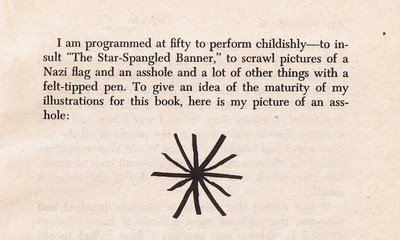
That may give you an idea of what to expect inside (although most of the illustrations are “better” than that one).
What is especially helpful about the story is that it tells you what will happen as it goes along. So the novel starts:
This is a tale of a meeting of two lonesome, skinny, fairly old white men on a planet which was dying fast.
One of them was a science fiction writer named Kilgore Trout. He was a nobody at the time, and he supposed his life was over. He was mistaken. As a consequence of the meeting, he became one of the most beloved and respected human beings in history.
The man he met was an automobile dealer, a Pontiac dealer named Dwayne Hoover. Dwayne Hoover was on the brink of going insane.
And that is literally the story. So why is the book 297 pages long then? Vonnegut is really out to talk about contemporary society: America mostly, but not exclusively. And does he ever.
One of the main topics is the state of race relations in America. There’s the subtle–everyone, regardless of the importance of their character is described as either white or black or tan (which is disconcerting to read because authors typically don’t point it out so explicitly)–to the outrageous: a sign (made somehow all the more horrible because he draws it as a picture) that says: “Nigger! This is Shepherdstown God help you if the sun ever sets on you here!”
But really, this book looks at how humanity is destroying everything good in the world: like the (fictional) Bermuda Ern or the river that runs through the local cave (Sacred Miracle Cave–which two boys stumbled upon. They made up a story, added some props and created a tourist destination). And especially how humanity is destroying each other (see, for example, the sign above). Indeed, the first chapter is a brief history of the United States. And it’s not a pretty one.
Listen: This novel is told as if the Earth were destroyed and anyone who reads the story wouldn’t know what planet the author is talking about. It allows the novel to take a kind of pedantic view that reads very funny but is quite serious. So you get brief explanations of what guns are: “a tool whose only purpose was to make holes in human beings” (49) (with an illustration–of the gun, not the holes). Or of Nazis: “the people in a country called Germany were so full of bad chemicals for a while that they actually built factories whose only purpose was to kill people by the millions” (133) (with an illustration of the swastika flag).
So the drawings are meaningful as well as simple. There are also illustrations of dinosaurs and apples and chickens and cows and crazy people and signs and clock towers and all manner of things. The drawings are simple yet effective. See some here.
There’s also a ton of statistics about penis size.
The story also allows for Kilgore Trout to be used as a mouthpiece for Vonnegut. Trout has written hundreds of short stories. He sent them to magazines (mostly porn magazines–WIDE OPEN BEAVERS INSIDE!) and they were all pretty much published, although he never sought them out or even got paid for them. Most of the time the magazine changed the title (to something suitably appropriate for a porn mag) but not the content (which was sci-fi, and not porn related at all). And Vonnegut includes excerpts from many of these stories in the book.
Most of them are funny, with a satirical edge that proves how curmudgeonly Trout/Vonnegut is. But the main story that impacts the novel is called Now It Can Be Told. This is the story that puts Hoover over the edge. The fictional novel is written as a letter to the reader. In the letter, the reader learns that he is the only person on the planet who is not a robot. Everyone else has been a robot forever. People act the way they do because they are programmed to do so. Hoover is in an emotionally unstable position as it is and this just tips the balance.
Of course, the inevitable question is, How did they meet? It all comes down to an arts festival. The funding for the Midland City Arts Festival came from Eliot Rosewater (yes, from God Bless You Mr Rosewater). He loves Trout’s work (as we know from that book) and insists that Trout be the featured speaker.
The novel follows Trout’s surprise at getting the notice (and the $10,000), his conflicts about whether or not he should even go and his subsequent road trip. He goes from Ilium NY through Manhattan (where he is shocked by so much) and eventually hitchhikes to the Middle West, as Vonnegut calls it.
While Trout is careening towards his destination, we see Hoover wandering around Midland City. Hoover’s life is a mess: his wife killed herself by drinking Drano, his son is a homosexual piano player named Bunny and his top sales man is a cross dresser (although Hoover doesn’t know that last bit, it is true). And when he arrives to work one morning he completely forgets that it’s Hawaiian week at the store, can’t imagine why there are palm trees on his sales floor, and goes a bit insane.
Hoover is the wealthiest man in Midland City and more than a few minor characterless would love to get his attention. Like Wayne Hoobler, the black man who was recently released from prison (and there’sa whole section about how Hoover’s family changed their name from Hoobler), or the young girl who works at Burger Chef who imagines that Hoover could take her away from her life (Hoover owns the Burger Chef chain too), to the other artists who have come for the Festival.
Even Philboyd Stuge himself becomes a character in his own book. He writes himself into his book right at the climax and describes how he can affect anyone’s actions. It’s funny and surreal and really clever.
The story isn’t laugh out loud funny per se, it’s wryly comic and very very dark. It may be a little too overwhelmingly dark to read in one day as I did. But the story was quite compelling. And of course, seeing the many characters from his other books was also quite fun.
As with most Vonnegut this summary does very little to explain all of what is going on here: like the nonlinearity of the story (we learn several significant items before they “happen” in the story), the asides about consumer culture (why would someone name a trucking company Pyramid, since the Pyramids are stationary objects? Maybe he liked the sound of the word.)
It’s another fun step in the Vonnegutian universe. And it is well worth reading even if you haven’t read the other books–the references are fun, but they are not dependent on the history of the novels.
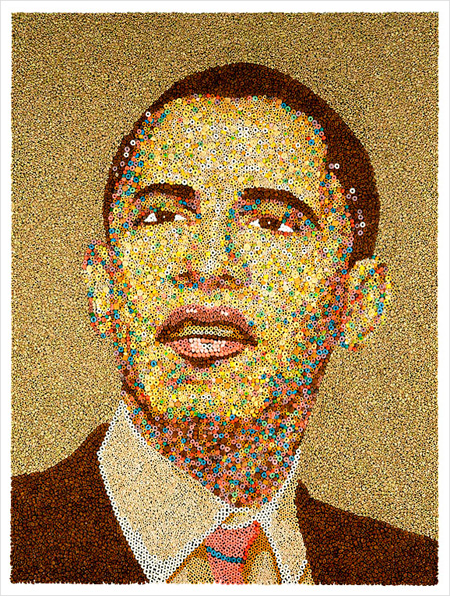
Note: this book has nothing whatsoever to do with this piece of art, which comes up when you look for the cover of the book, called Breakfast of Champion:

 I Just Read About That...
Leave a comment