 SOUNDTRACK: WAVVES-Live at the 9:30 Club (2010).
 Wavves opened for Best Coast (what a great double bill). Wavves play a raucous, rowdy set of bratty punk. Unlike Best Coast, the lead singer seems like he might be something of a jerk. But it played pretty well into the personality of the music (sloppy, abrasive). And I wonder just how many times he said he was drunk?
Personalities aside, the was a really fun set. I have the newest Wavves album, but I think their live show was more engaging. For all of their sloppiness, the band was always together, with no missed notes (except when the drummer was apparently not paying attention).
They play 16 songs, including a cover of Black Flag’s “Nervous Breakdown” (which the play very well). And even if you’re not won over by the singer’s personality (which is kind of funny), you’ll be won over by the simple, punky music. You can listen here.
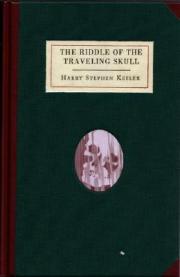
[READ: March 29, 2011] The Riddle of the Traveling Skull
This is the 4th book in McSweeney’s Collins Library Series. It’s the final book in the series that I’ve read and I have to say that once again, Paul Collins has blown me away with this selection. Collins apparently stopped his library after 6 volumes. I wondered if there were more coming, but the Collins Library website is rather confusing. There’s an almanac with updates as recent as March 1st, and yet the Biography of Paul Collins says: Paul Collins is currently on tour in support of his memoir, Sixpence House, which recounts his time spent living in the Welsh town of Hay-on-Wye, known as the “Town of Books.” But Sixpence House came out in 2003 (and it sounds awesome!).
Anyhow, back to this book, which was my favorite of the bunch. It is a genuine mystery from 1939. Indeed, Harry Stephen Keeler was even more prolific than Agatha Christie (they were born in the same year). The thing about Keeler though is that his stories are, well, crazy. Many of his stories were just his attempts to meld disparate ideas into one story. He includes crazy dialect. He seems to have no concern for conventional storytelling. Indeed, he has little concern for conventional mystery storytelling (in one of his stories, he introduced the murderer on the last page).
And this story has similar improbable elements.
In sum: Clay Calthorpe, a salesman returning from the Philipines picks up the wrong bag on the trolley. When he gets home he finds a skull inside it. The skull has a name plate affixed to it, a bullet inside it and, in the wads of paper that are keeping the bullet from rattling around, he finds the carbon copy of a poem.
I would love to try to recap this mystery but it is so convoluted (and wonderful) that it’s not worth the effort trying to recall all the details and twists and turns (I can’t imagine how he kept it all straight). So I’ll summarize as best as I can.
The salesman speaks to his friend John Barr of Barr Bags (there is a huge, hilarious section about the making of these bags) who says he knows a) a guy who has been receiving poetry submissions for a new magazine and b) a doctor who does brain surgery and who affixes name plates to the skull when he is done. [Keeler is quite keen on coincidence, but who cares].
The salesman tracks down both of these leads with moderate success. From the poetry magazine we learn that Clay hates poetry but that he rather likes the simple poems of Abigail Spruggee. From the doctor, we learn an amazing amount about trepanning, about the tools involved in the procedure (to create a bevelled edge), and that doctors often affixed nameplates to skulls that they’d operated on so they could learn more information after the person had died. [You see, this book tends to wander a bit, and yet all of the wanderings were fascinating and engaging–Clay is a great narrator].
When he finally calls on his girlfriend/fiancee to explain all that happened, her father suddenly faints dead away when he hears about the skull. In the morning the father (who is quite fond of Clay) calls off the engagement. Evidently the father is mixed up with the skull somehow.
And that’s all I’m going to reveal of the plot because there are so many wonderfully weird surprise revelations that it would be mean of me to prevent readers from enjoying them.
I’ll just add some of the things to look forward to: a Chinaman [yes, it’s racist] who spouts the Bible, a Negro janitor [wait] who is an idiot [wait] who is also a master jigsaw puzzle solver [good grief], a ventriloquist’s dummy, a woman who tries to sucker men out of money by claiming they proposed to her [yes, it’s sexist], a multi-limbed circus freak known as Legga the Human Spider [seriously], all manner of Cockney accents (and Clay’s attempt at repeating them), the fictional country of San Do Mar, where no one can be extradited for a crime, and an amazing fondness for the city of Chicago. (Keeler is from Chicago, and the amount of Chicago love on display is staggering).
But my favorite thing in the book was that on page 187 there is a page break that says:
“Stop! At this point all the characters and the necessary clues have been presented to make it possible for you to determine the true identity of the blackmailer.” And at the bottom of the page is a section for you, the reader, to fill out stating how many pages you have read, who you believe the blackmailer to be, your reasons for your guess and the enigmatic “If I am Wrong, I will____________________”
The mystery of the story was impossible for me to figure out. In fact, by the end of the story, when the blackmailer is revealed and Clay puts all the pieces together, I’m couldn’t even keep straight which parts were supposed to have really happened. There were so many clever (or not) twists of common sense, that even when it was explained away, I’m still not sure I followed it all.
But I don’t care. It was a great read, a fun story and a whole bunch of wild nonsense. I don’t know if the rest of his books are available anywhere, but I’d certainly read another of these crazy stories.

 I Just Read About That...
Leave a comment