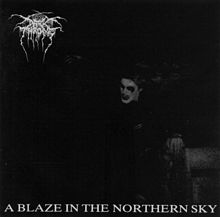
 SOUNDTRACK: DARKTHRONE-“Kathaarian Life Code,” (1992), “Sacrificing to the God of Doubt” (2004), “Canadian Metal” (2007).
 After watching Until the Light Takes Us, I wanted to check out some of Darkthrone’s music. According to their Wikipedia page, over the years the band who pioneered black metal has morphed away from the sound. They’ve added elements of punk and speed metal to their bludgeoning sound. In the movie Fenriz says that he listens to all kinds of music and is very open-minded.
“Kathaarian Life Code” is a ten minute dirge of black metal. It opens the band’s second album (considered to be a black metal classic) with chanting and guttural spoken words. Then it blasts forth with the jackhammer style of drums that is now standard in black metal.
It slows down from time to time, allowing for the really heavy parts to blast through the chaos of the fast parts. It’s pretty intense and not for the faint of heart. You can hear occasional guitars screaming through the din, but the production is intentionally murky, dark and noisy. As they say in the movie, the bands intentionally recorded on the shittiest equipment they could find.
“Sacrificing to the God of Doubt” is a later song, taken from what is considered their final album in the black metal style. The band was turning away from the traditional black metal sound, and there are elements of punk (guitar riffs that are audible, and a sound that is less bass heavy) present. And the production, while still mired by noise is relatively cleaner.
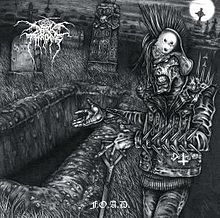 “Canadian Metal” is from their third most recent album, after the shift from black metal was more or less official. It sounds more like an early death metal song. There’s low tuned notes, audible vocals (growled, but you can actually hear words) and a kind of headbanging aspect to it. The album is called F.O.A.D. which was a song by Venom (and others, obviously), and this track reminds me of Venom somewhat. I wouldn’t say that the band has sold out because there’s no way anyone is playing this on the radio, but it’s interesting to see how a band has managed to change things up and add new elements to its sound even though they were the forerunner and grandfather of a scene.
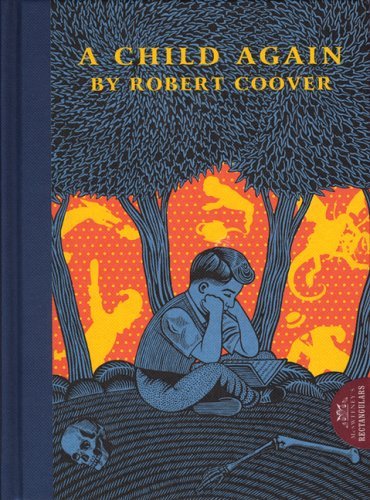
[READ: February and March 2011] A Child Again
This is a collection of short stories from Robert Coover. There is a kind of theme throughout (most of) the stories about returning to childhood. But the overall sense is one of despair, sadness, pointlessness and sex. Lots and lots of sex. And the sex is usually as vulgar and nasty as the tone of the book suggests it would be. It’s a little off-putting, actually.
I was planning to say that I didn’t like this collection at all because I really didn’t enjoy the first half-dozen or so stories. I continued because Coover has a great reputation that I didn’t want to give up after a few misfires.
The real disappointment came because the stories seem so promising: many of them are a kind of retelling of classic fairy tales that looks at “what happened afterward.” However, and this was true for almost all of them, Coover tries to do two contradictory things with the stories. He is playing with fairy tales but he is also writing stories that are completely unlike fairy tales. By that I mean, Coover’s stories are long and very detailed, they bring far too much information to the story. And a fairy tale is almost by definition short. I mean, “Puff the Magic Dragon” is a song that’s about five paragraphs long. But Coover’s “Sir John Paper Returns to Honah-Lee” is 26 pages long. So instead of playing with the original, it feels like an original story that uses someone else’s characters. It’s unsettling and unsatisfying.
It’s also not very funny. And I’m not sure fit’s supposed to be. But with a title like “Sir John Paper Returns to Honah-Lee” you expect the funny. And there are funny moments. I mean the whole premise is that little Jackie Paper has grown up into Sir John Paper. He’s now an old Knight and he is sent to slay the dragon (Puff) who is plaguing the city. Even though that is a tragic story, it is also inherently humorous. And there are laughs when they reunite. But it gets so bogged down in details, that the essence of the story seems to get lost. Perhaps I’m just disappointed because it (they) turned out so unlike I wanted them to be.
“Punch” is an investigation of “Punch and Judy” stories from the point of view of a manipulated Punch.
“The Invisible Man” is an amusing story (and at only ten pages it doesn’t overstay its welcome) of the invisible man’s life of crime (he was fed up with doing good). He can only take little things (where would he stash anything else?), until he thinks he meets another invisible person. And his life changes utterly.
“The Dead Queen” plays on Snow White and the Seven Dwarfs. I found this story confusing (but I had kind of had it with the book at this point). It basically seemed like an opportunity to write a sex scene with the seven dwarfs.
“Playing House” was an endless, endless story of people trying to get out of a house or build a house within a house or something. It was a recursive story (and I enjoyed the end because of that), but I simply didn’t care about the people or the story for most of it.
There were three “Puzzle Pages.” Although none of them are really puzzles per se. “Riddle” is about an execution. It is convoluted and would work better if not presented as a riddle (there is a kind of riddle at the end but I don’t know if anyone would ever bother trying to figure it out). The second, “Chicago Cryptogram” has some fun with wordplay and philosophy.
“The Fisherman and the Jin” was the first story I liked. (Note that it is only 3 pages long–this seems to be my general consensus with his stuff: shorter is much much better). It concerns a genie and how indecision can cost you.
“Alice in the Time of the Jabberwock” was a long story (37 pages). And I liked it more than I didn’t like it. In fact, I liked it quite a lot. It is (obviously) about Alice in Wonderland. It follows after the events of the story and essentially takes place after Alice believes she has returned home. She wakes up and realizes that she is still in Wonderland (she exists only in the Mad Hatter’s dream.) It’s a clever story with linguistic jokes–I was really quite impressed with Coover’s pseudo-Carroll style. And there’s a lot of fun at Alice’s expense by the linguistic nonsense of the other characters.
Then it gets really nasty. Suddenly Alice is revealed as a fat, disgusting older girl. The other characters are really mean to her and it gets misanthropic really fast. I know that Coover revels in misanthropy, but it seems wrong to me to take a classic character and do this to her. And maybe that’s why I don’t like these stories, it seems like they are really easy targets and don’t deserve this kind of treatment.
“The Fallguy’s Faith” is two pages long but I’m not sure about what.
“The Return of the Dark Children” was also long, but it was really superb. This turned out to be my favorite story of the collection. It is a follow-up of The Pied Piper. But I think the reason this story was so much more successful than the others is that it doesn’t follow any of the characters in the original. Not even the Pied Piper himself appears in the story. Rather, it takes an almost unspoken part of the story and tries to follow it to its logical conclusion.
Basically, the kids who went off with the Piper have returned as “dark children” and ever since their arrival (no one can see them, but they know they are there) things have been going very badly for the town of Hamelin. It is a tale that is full of misanthropy and horror, and yet despite my objection to that in other stories) it works very well here.
The story creates an atmosphere where the adults must make horrifying choices about what to do with their children. After the townsfolk lost their first children to the piper (in the original), they had more children, but now those children are getting killed almost every day. And, the rats are back, too. They are everywhere, multiplying and causing unspeakable acts in the city.
Then the townsfolk notice that every time one of their children dies, the rats numbers decrease. Could this be causation? Should they try to head off the rats by doing the unspeakable? It’s an awful story and I couldn’t stop reading it. This was Coover at his best.
“The Presidents” was a pretty obvious bash at politicians as a distinct (and reprehensible) species. Even at six pages, I felt this was way too long.
“McDuff on the Mound” was a retelling of “Casey at the Bat” from the point of view of the pitcher. It was an outrageously absurdist story. And as with other Coover stories, I enjoyed a lot of it (I was really curious how he would end it) and exasperated by other parts of it. He employs buffoons on Casey’s team, who engage in cartoon slapstick that it so over the top nonsensical that it drove me insane (which I think was the point). But holy cow I wanted to scream at the story.
“Grandmother’s Nose” is a twisted take on Red Riding Hood which I liked because he recasts it as a way of coping with death.
The final puzzle Page “Suburban Jigsaw” stands out in the book because it is unlike any other. Essentially it is the story of a small town in which every resident is having sex with someone else in the town, just not his or her own spouse. I lost track of the all of the characters and the pairings, but suffice it to say it is twenty pages of adultery, kinky sex and more kinky sex. And it’s this kinky sex which seems to keep the whole town afloat. But god forbid if anyone found out there was adultery going on….
“Stick Man” was also a good story (the collection really picked up by the end). And I think it was good because it doesn’t tackle a known story, rather it take as its premise the living character of a stick figure. The stick figure comes to the human world where he is derided and abused and eventually put on TV to be gawked at. Eventually a superhero comes to his rescue, but for the most part he is humiliated.
It’s a heavy-handed indictment of humanity, but it works pretty well. And, again, I couldn’t wait to see how he pulled it off in the end. It also has the distinction of ending on a simultaneous note of happiness and despair. It’s a bit long, but it’s very effective.
“The Last One” was another cool story. In it, a king lays a task to all of his new brides: you may do whatever you want in the castle but do not under any circumstances, go into the blue room. He is on his umpeenth wife (the punishment of going in the blue room is death, although they do not know that until they go into the blue room). This new one seems totally uninterested in his stupid blue room. She loves him passionately, sexually and unquestioningly. And yet he is still dissatisfied with her? And, just what is she up to in that room of hers? The ending is wonderful.
“Aesop’s Forest” was, again, simply too long. The premise was intriguing: what happens when the characters in Aesop’s forest age. Specifically, the lion is getting too old to be a threat. I was confused by who exactly some of the characters were supposed to be, (I think Coover either expected more from me or wrote in a cryptic kind of abstract way) but for the most part the allegory worked well. By the end, I was fully on board and felt that he dealt with the premise very well. It was just way too long.
“Heart Suit” is a bonus story that came with the book. It is a printed on a “deck of cards.” Specifically, it is printed on the hearts of a deck of cards (hence the title). The fun of the story is that you are supposed to shuffle the cards and have the story tell itself in a different way each time. It was a neat little gimmick. I’m not sure it works in every scenario (I tried only one). But the story itself is not all that compelling. It is basically the king of hearts trying to find out who stole the tarts (all on a summer’s day). Each card details the inquisition of a different suspect. But it’s rather repetitive. A neat trick but little else.
So, overall this book was a chore. I had to space out these stories every few days because I didn’t really like them that much. Even the ones I did like were long and not always easy to finish in one sitting.
I’ve heard that his early books, specifically The Universal Baseball Association, Inc., J. Henry Waugh, Prop. (1968), Pricksongs & Descants (1969), and The Public Burning (1977) are supposed to be very good. It’s unlikely that I would read any new fiction by him, but I think one of these days I would consider one of these earlier books.
Having said all that, the artwork in the book is beautiful. From the gorgeous cover to the cool designs on the inside cover, it’s really nice to look at.

 I Just Read About That...
Your comments on Coover are concise and honest and sound like the kind of thing I would say; I have trouble reading mroe than a handful of pages of anything by Coover. Charmed by the first two pages, tired by five and six. I keep trying him because of my admiration for “The Universal Baseball Association.” That is a stunningly original and rewarding novel, and I recommend it to you.
Thanks for this recommendation, I will totally check it out!