 SOUNDTRACK: BIG DIRTY BAND-“I Fought the Law” (2006).
 I just found out about this “supergroup” which was created for the Trailer Park Boys Movie. The group consists of Geddy Lee and Alex Lifeson from Rush, drummer Jeff Burrows from The Tea Party and three people I don’t know: the singer from Three Days Grace, the singer/guitarist from Thornley and on lead vocals Care Failure from Die Mannequin.
I have to say that I’m not that excited by this cover. The song has been covered so many times (some very good: The Clash, some very clever: The Dead Kennedys, and some terrible: many others). And frankly there’s not much that you can do with this song. It’s simple in structure with potential for shouting (which everyone likes), but little else.
For Rush fans, you can’t tell that Geddy or Alex are even on it. So really it’s just a kind of metal-ish version of this old song.
Oh well, they can’t all be zingers. You can hear it here.
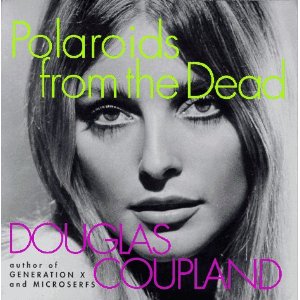
[READ: February 1, 2011] Polaroids from the Dead
After reading Shampoo Planet, I wanted to see if I remembered any of Coupland’s books. So I read this one. It’s entirely possible that when I bought this book I was disappointed that it was not a new novel and never read it. Because I don’t remember a thing about this book. (This is seriously calling into question my 90’s Coupland-love!).
But I’m glad I read it now. It’s an interesting time-capsule of the mid-90s. It’s funny to see how the mid 90s were a time of questioning authority, of trying to unmask fame and corporate mega-ness. At the time it seemed so rebellious, like everything was changing, that facades were crumbling. Now, after the 2000s, that attitude seems so quaint. Reading these essays really makes me long for that time when people were willing to stand up for what they believed in and write books or music about it (sire nothing changed, but the soundtrack was good).
So, this collection is actually not all non-fiction. Part One is the titular “Postcards from the Dead.” It comprises ten vignettes about people at a Grateful Dead concert in California in 1991. As Coupland points out in the intro to the book, this was right around their Shades of Grey album album In the Dark, and huge hit “Touch of Grey”, when they had inexplicable MTV success and it brought in a new generation of future Deadheads. He also points out that this is before Jerry Garcia died (which is actually helpful at this removed distance).
These stories are what Coupland does best: character studies and brief exposes about people’s lives. The stories introduce ten very different people, and he is able to create a very complex web of people in the parking lot of the show (we don’t see the concert at all). As with most Coupland of this era, the characters fret about reality. But what’s new is that he focuses on older characters more (in the first two novels adults were sort of peripheral, although as we saw in Shampoo, the mother did have millennial crises as well). But in some of these stories the focus is on older people (Coupland was 30 in 1991, gasp!). And the older folks fret about aging and status, just like the young kids do.
My favorite joke is that old dudes in the parking lot are clearly “doing” something. When the youngsters who are trying out all kinds of drugs finally approach to see what they’re doing, one comes back disgusted and says, “contact lenses.” Ha!
Whether or not you like the Dead (or their fans) will not impact your enjoyment of the stories. They look at many different people (young people trying the Dead for the first time, die-hard fans, and accidental ticket holders), but the setting is immaterial to what Coupland is trying to write about: a sense of community. And, is a Dead show’s arbitrary community any less real than any other?
Part Two, “Portraits of People and Places,” contains a series of short non-fiction pieces. The topics include:
 The Lions Gate Bridge in Vancouver (he is fond of it and does not want to see it destroyed). I am now happy to read that it has been declared a National Historic Site.
- The German Reporter (a 24-year-old reporter comes to interview him and DC embraces him as a friend, showing him all of his local haunts).
- Former East Berlin (they are reluctantly embracing capitalism, but their service sucks)
- Kurt Cobain (a letter written to him after his coma and then continued after his suicide–it is passionate and surprisingly affecting).
- Graveyards in West Vancouver (he used to hang out in them as a kid)
- The Bahamas
- Palo Alto (its existence as a city of exclusively corporations)
- James Rosenquist’s F-111 (a pop art painting that sounds very cool and which leads DC to investigate the nature of art and pop culture). This was my favorite of these pieces.
- Los Alamos (and the nuclear history museum). This one was interesting for its general sense that the U.S. was somehow post-nuclear, which proves to be not so true anymore.


F-111
The last piece in this section is four “micro-stories” set in Washington D.C. Like The Dead stories, they look at four different people who live in D.C. These were more character studies and showcased a somewhat underrepresented strata of DC in fiction.
Part Three is “Brentwood Notebook.” DC explains that he initially wanted to write an article about Brentwood because of its existence as a non-place, a “suburb” devoid of any kind of personality. Rich people live there and basically try to hide there. Nobody wanted to print the article for exactly this reason. And then the O.J. Simpson murder scandal happened; his precis changed and now there was actual interest in the piece.
I didn’t know a thing about Brentwood (I deliberately did not follow the O.J. trial, and did not even see the Bronco/freeway nonsense that everyone was glued to), so I was surprised to learn that that’s where Marilyn Monroe died as well. And so, DC goes to Brentwood on the anniversary of Monroe’s death and writes about this non-place. It’s not about O.J. or Monroe; rather, it’s about Brentwood as a kind of void. And he takes this concept, living a void, as the foundation of the article.
It’s very long and covers several things from different angles. He talks a lot about life in the mid 90s, and how the quest for fame seems to eclipse people’s lives. But his interesting twist on this is that once people become famous they also seem to try to escape their lives, sort of living outside of life.
I am intrigued by his concept of de-narrative, that there are so many things which remove us from the story of our lives. And really that is what we all want, a story for our life. That has been the point that DC has been making in pretty much all of his fiction and non-fiction, but he is rarely as explicit as he is here. And it is compelling.
So, yes, this collection is itself like a Polaroid, a time capsule from a not so distant past which seems distant. If you’ve never read Coupland, this book is not a great place to start for his fiction proper, as, obviously, there’s nothing more than a few pages in here. The photos included in the book are also not photos that DC himself took (you’ll have to look for his art books for that), rather they are mostly stock photos, all black and white, which accentuate the stories.
However, this is probably the best place to start if you want to get a handle on his beliefs and ideals, and his non-fiction style. The fiction is also fun, more for its proto-flash fiction style and to get a handle on the kinds of stories he builds his larger works around. It’s also fascinating how un-Canadian Coupland really is (especially for a writer who is known for being Canadian). Yes he lives in Vancouver, but he travels all the time and, as you can see, he writes about the world.

 I Just Read About That...
Hate to do this (actually, I love doing things like this) but the Dead album was titled In The Dark (1987). The single which made Top 10 and got all the college kids buying rabbit poo or oregano from Deadheads in parking lots was Touch of Grey. 1991 was further on into their demise, a difficult year as they kept getting bigger and had been banned from several cities because of their fan’s extracurricular activities with said rabbit poo.
Your take on Coupland is spot on, as far as I’m concerned. I think he gets away with a very loyal and indulgent readership but that he has a lot to offer, a view of the world which reminds me of some of Bryson’s work in a way.
Thanks, as usual.
There’s no excuse for laziness (or trusting your memory from college).
It’s interesting to read Coupland while no longer caught up in it. A somewhat useful nostalgia.