 SOUNDTRACK: THE WEAKERTHANS-Live at the Burton Cummings Theatre (2010).
 I’ve enjoyed The Weakerthans for a few years now, so I was pretty excited to see they had a live album out.
This live album works like a greatest hits. All of the songs are great catchy pop songs–why aren’t The Weakerthans huge? Maybe because their songs are literate and clever (and have weird titles (like “Our Retired Explorer (Dines with Michel Foucault in Paris, 1961)”). In fact that song is one of only two songs that I know of that mention Jacques Derrida (the second being Scritti Politti’s “Jacques Derrida”).
Admittedly, The Weakerthan’s songs are simple and catchy and these live versions aren’t radically different from the originals. There’s no extended jams or maniacal freak outs or anything. But the album is very charming (John Samson is unfailingly polite) and the one big surprise is quite a surprise!
On the track “Wellington’s Wednesdays” Samson introduces a guy: “This is Ernesto. He’s from Mexico. He’s going to play a guitar solo.” While listening to the disc I couldn’t imagine this peculiar introduction for a band member. My version of the disc comes with a concert DVD of the show. I didn’t get to watch the DVD until recently and… mystery solved: Ernesto is a fan in the front row. Samson talks to him mid-song, pulls him up on stage, introduces him and gives him his guitar to play the solo! Then Samson jumps into the front row to watch. How cool is that?
The video doesn’t deviate from the audio, except for leaving in a few moments of patter from Samson. In fact, I found the video to be somewhat choppily edited. When Samson plays “One Great City!” (solo…which wasn’t obvious from the audio. I mean, you can tell he’s solo, but it’s much more dramatic in the video) at the finish of the song, it immediately cuts to the next full band song, rather diminishing the return of the band. (Although I do like the jump cuts to the audience which reveal what appears to be a room full of teenagers–it’s adorable!)
The other confusing thing is that the recording notes say that it was recorded over two days, and yet the video appears to be one night’s show. And the audio matches it, so who knows.
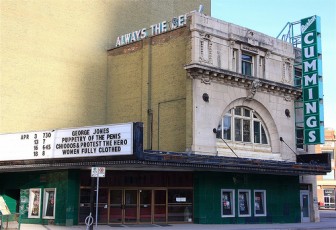 But those are little quibbles. The music is great, the sound quality is fantastic and the song choices are great. There are some cool surprises on the disc (like the horns and violin), but mostly what you get is an enjoyable evening at a small hometown concert with fans who love to sing along to the chorus of “One Great City:” “I hate Winnipeg!”
[READ: December 18, 2010] Stephen Leacock
What I’ve really been enjoying about this series of Extraordinary Canadians is how the writers of the books (at least the three I’ve read so far) are writing in such very different styles. Obviously Coupland did his own thing. Vissanji is a novelist, and he wrote his in a more novelistic way (its not like a novel at all, but it’s constructed in a kind of narrative style). Macmillian is a historian, and I suppose for that reason, this biography feels more like a history (of Leacock, but also of economics) than a simple biography.
The strangest thing about this book is that although MacMillan obviously likes and respects Leacock, a surprising amount of the book is taken up with her talking about things he either said or did wrong or about his books that really aren’t that funny. This is surprising because Leacock is a noted humorist. (In 1947, the Stephen Leacock Award was created to recognize the best in Canadian literary humour).
This biography looks at his life, but mostly it focuses on his academic and humorous works. Leacock was an economist although he seems to generally disapprove of economists. He had begun by teaching high school but found it incredibly stifling. Eventually he found his niche at McGill University where he was well-respected and highly regarded by students and faculty alike.
What I enjoyed about the discussion of his academic life is that MacMillan mentions what he was making at his job (about $5,500 a year) but that he would often do speaking engagements or articles that would earn him $350 a pop. It shows how much he enjoyed the prospects and promises of teaching that he continued to teach even though he could have made serious money just as a lecturer.
His lectures were quite a draw, and even gave him enough prominence that he was quoted often. In fact, Leacock is probably considered the first Public Intellectual.
The odd thing about this biography is that MacMillan really only ever talks about one of his comic essays (that’s not exactly true, but she mentions “My Financial Career” by name four times in the first half of the book..and let’s not forget the story is only 6 very small pages long–it almost seems like he was a one hit wonder). “My Financial Career” comes from the book Literary Lapses (you can download the entire book here –and yes it is quite funny) and seems to be the one that set him on his career as a humorist.
Aside from that story, the biggest thing I took away from this biography was the Leacock was a mass of contradictions. In his writings he was very conservative, he especially had an active dislike of women at universities (it distracts men and besides, women have “different aptitudes” (80). And yet in his professional life as a teacher he was very supportive of women, giving them excellent recommendations and encouragement. To one female student he wrote “for people who have brains and energy and youth, the world is still wide open” (80).
Indeed, there were many aspects where he did not follow his own particular advice. He often tried to embrace England at the expense of the United States, and yet he also never wanted to move back to England (he was born there) because he couldn’t imagine being far from the U.S.
And yet, on many things he was insistent and unmovable: He disapproved greatly of Prohibition, and wouldn’t speak at an event if it was a dry one. It’s this trait (not about Prohibition but the inflexibility) that MacMillan claims over and over (and over) is the flaw in Leacock’s writing. Whenever he was passionately angry about something it made his writing suffer. It seemed that even if he was trying to be funny, when he was passionately angry, his writing came across as just angry: sarcastic and bitter without ever being funny. In fact, she names several books that she thinks are not funny at all.
In particular she thinks that his writings about humor (Humour: Its Theory and Technique and Humour and Humanity) are quite terrible (and are not funny…the example he gives to accompany his analysis “fall far short of his best work” (52). His theories are based on “dubious science and equally dubious history” (52). He also believed that humanity was evolving away from slapstick to a more genteel style of humor (history has not borne this out, obviously).
Despite all of the criticisms of Leacock’s life and work, MacMillan leaves us with the final chapter which categorically states that Leacock is a national treasure, instrumental in creating what is casually known as Canadian humor.
MacMillan recommends these books (from his some 52 releases) Literary Lapses, Nonsense Novels, Sunshine Sketches of A Little Town (the small town is Mariposa, based on his home town of Orillia) and Arcadian Adventures with the Idle Rich.
Although I didn’t come away from this book dying to read his works (like I did with McLuhan and Richler), I did actually download his first book of short stories. Perhaps I’ll read Literary Lapses in bits and pieces.
And, here’s a shameless plug to the folks at Penguin Canada–I will absolutely post about all of the books in this series if you want to send me the rest of them. I don’t know how much attention these titles will get outside of Canada, but I am quite interested in a number of the subjects, and will happily read all of the books if you want to send them to me. Just contact me here!

 I Just Read About That...
Leave a comment