 SOUNDTRACK: BUKE AND GASS-“Page Break” (2010).
 NPR has selected the 50 best CDs of 2010. I knew a few of them but had never heard of a bunch of other ones (about 20% are classical). This CD with the bizarre cover has a great write up:
The wannabe tech-geek in me was initially attracted to Buke and Gass for the band’s two handmade instruments, which modify a baritone-ukulele and a guitar/bass hybrid run through heavy-duty amps (also handmade, mind you).
The problem (and perhaps its because I’m listening at Xmas time) is that the main melody line of the bridge makes me want to sing “Hark, Hear the Bells” and so this feels like a Christmas song even though it’s not.
Whoops– check that. That melody is certainly there, but I just learned that I was listening to it in mono. The other speaker presents all kinds of interesting things that distract from that melody (and project much more coolness).
I like the intensity of the track (and the fact that it’s under 2 minutes long). It’s pretty heavy and the female vocals are nicely aggressive. And by the end of the song, the syncopation is downright awesome.
It’s amazing how listening to the ENTIRE song can really change your mind. This is definitely a cool track and will make me investigate the band more.
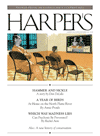
[READ: December 22, 2010] “One Night of Love”
I had recently gotten interested in reading Javier Marías when I was looking for information about Roberto Bolaño. I discovered that New Directions Press, the publisher of all of Bolaño’s smaller books also published translations of all of Marías’ books too. This story comes from his new collection of short stories While the Women Are Sleeping. (I had also forgotten that McSweeney’s published his book Voyage on the Horizon a few years ago).
I didn’t know where Marías was from when I first started this (I assumed he was Mexican because of the New Directions connection–he’s actually from Spain). Anyhow, when I thought he was from Mexico, I wondered if there was some kind of connection between his style and Bolaño’s, but also if he was trying to reintroduce magical realism to Bolaño (who abhorred magical realism).
Well that’s moot, (he may be doing that but not because he is from Mexico).
So this story concerns a man who is dissatisfied with his wife’s sexual appetite and performance. He has taken to visiting prostitutes (see why the Bolaño thing rang true?), but he is concerned because the prostitutes have grown “increasingly nervous and increasingly expensive” ([Nervous]?).
Then the narrator shifts his focus to a group of letters that his father gave him upon his death. The letters are all from a woman who is, explicitly, already dead (not metaphorically dead). They talk about how wonderful a time they will have when they meet again. The narrator is moved by the letters (his father was widowed at the time) and holds on to them.
The narrator soon receives another letter from the dead woman. There is a problem: the woman was cremated, and, although his father wished to be cremated he was bodily interred in the family plot. The dead lady requests that he dig up his father and have him cremated so they can be together. He disregards the letter. Soon though, he receives another one in which she states that he (the narrator) can do whatever kinky thing he wants to do to her if he will just have his father cremated so they (she and his father) can be together. He doesn’t even consider it, although that night, for the first time in years, his wife feels sexually frisky.
You can see where this story is going, but Marías has fun with the story and flips expectations at the end.
I was really delighted by the story, especially the end. The translation by Margaret Jull Costa is terse and explicit, not flowery. I have no idea if it is representative of his other stories, but it certainly was a good place to start.
For ease of searching I include: Javier Marias and Roberto Bolano

 I Just Read About That...
Leave a comment