 SOUNDTRACK: LETTERS TO CLEO-“Cruel to be Kind” (1999).
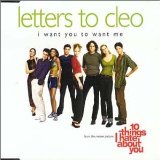 I’ve liked Letters to Cleo since I first heard them back on WFNX radio in Boston. And since I had a dog named Cleo and their album was called Aurora Gory Alice, how could I not love them?
This cover of Nick Lowe’s song comes pretty close to the end of their career when they were poppier and slightly less indie. In fairness, they were always a poppy band and their hooks were irresistible, but they had a bit more of an edge in the beginning.
This cover is pretty spot on. There’s not a lot of “Cleo” put into it. It sounds a lot like the original, only sung by the wonderfully voiced Kay Hanley (she sang Josie’s parts in the (terrible) Josie and the Pussycats movie, the title song for My Friends Tigger & Pooh and (gasp) as a backing singer for a Miley Cyrus tour (that’s the sound of my indie heart breaking). I love her voice (she has a strange pronunciation/accent of some words that I find endearing), so I find the LTC version better than the original, but it’s honestly not all that different.
[READ: Week of November 16, 2010] Consider David Foster Wallace [essays 4-6]
These three essays cover the novella “Westward…” and Infinite Jest. I was pleased to begin the essays about IJ because I know that novel far better than I know the short stories or Broom of the System.
As I mentioned in the previous entry: because I don’t have a lot to say about the pieces, I’m only going to mention things that I found puzzling/confusing. But be assured that if I don’t mention the vast majority of the article it’s because I found it interesting/compelling/believable. I don’t feel comfortable paraphrasing the articles’ argument. Besides, what would be the point of that?
PHILIP COLEMAN-“Consider Berkeley & Co.: Reading ‘Westward The Course Of Empire Takes Its Way'”
As I said, I don’t know this story all that well. But, I have to say that I am persuaded by Coleman’s argument. His thesis is that everything in a novel is strategic and that close reading will reward the reader. He admits that not everyone can give a novel the kind of close scrutiny it deserves and that even in critical analysis some things can be overlooked. This applies to “Westward” in the way that DFW left signposts for how to read this story right in the very epigraphs he chose.
Coleman cites as a major signpost Irish philosopher George Berkeley. DFW cites him in Everything and More, but more significantly, the title of “Westward…” comes from a line in Berkeley’s poem “Verse on the Prospect of Planning Arts and Learning in America.”
I can go along with all of this. As one of the group readers puts it: This passes the sniff test (I love that phrase!)
GREGORY PHIPPS-“The Ideal Athlete: John Wayne”
I was intrigued by the opening of this essay, but I have to say that I felt that the title was somewhat misleading when I finished the essay. It feels to me that there are two very distinct essays at play here and that they never really connect.
The first thesis, which is quite convincing and interesting, shows Canada as a scapegoat in the book. Plenty of examples are given, many things that I didn’t really notice are mentioned and it’s all well-reasoned. Of course, as with many academic treatises, some things go too far in trying to prove a point (claiming that Schacht’s observation that ETA’s snow-covered lung looks like the “inflated shape of a distended igloo” (79) is some kind of anti-Canadian sentiment seems to be pushing the Canuckaphobia a bit), but otherwise it’s well argued.
True also, the arguments about John Wayne being a machine, undead, a cypher and that making him an excellent athlete. I also like the whole bit about Wayne’s past being an ideal setup for a sportswriter’s piece. But again, I think arguing that Steeply wouldn’t write about him because he was Canadian seems pushing the issue somewhat. Nevertheless, he does appear to be the ideal athlete.
The real problem is that even though John Wayne is a Canadian, I don’t see how that ties into the whole first part about Canada being a scapegoat. Even after the second read, I didn’t see where the two threads tied together. So I believe all of the anti-Canadian ideas (and I get that the jokes and abuse evince an undercurrrent of general hostility towards Canucks). And I’m totally on board that John Wayne is the ideal athlete. I’m just not sure what part one has to do with part two.
DAVID HERING-“Infinite Jest: Triangles, Cycles, Choices & Chases”
I enjoyed this essay very much.
When I first heard the David Silverblatt interview that Hering cites, I was intrigued by the whole concept of the Serpinski gasket. And when DFW revealed that the edits in the first draft altered the shape of the internal gasket I was somewhat idealistically bummed, even if I never intended to actually investigate the structure of the gasket within the story. So, I’m glad Hering did it for me.
And I have to say that the early arguments are really spot on. Chapters are short in the beginning and exponentially longer by the end; the gaps in the story lead to more explanation later on as well as micro-sized narrative absences; this is all convincing.
I was also convinced by Hering’s argument about the triangular paths that both Lenz and Poor Tony take while running around Inman Square (the diagrams are most helpful–I never actually realized that the two were in the same turf.
DFW’s interests in math certainly lend credence to the illustration that geometry played a large part in the novel. I doubt that I would ever have looked for or determined this kind of structure on my own, but when I re-read IJ someday, I’ll keep it in mind.
The only gripe I have with this essay is the constant barrage of improperly matched pronouns in the article. I’m a bit of a grammar fiend, so seeing sentences like: “a pattern of behavior in which the individual is physically restrained, their movement dictated by a personal obstacle which refuses to release them from a specific path” hurts to my grammar bones (emphasis mine). While I approve of the attempt at gender neutrality, forsaking grammar for it is teeth-grindingly painful.
————
Because of the Thanksgiving holiday, I won’t be posting about Consider David Foster Wallace for two weeks. I’ll have a whole bunch of articles read by the time I get back from holidays.

 I Just Read About That...
Just posted my note to the list about Coleman’s article. I’m holding off on reading your responses here until I’ve articulated my own so that I don’t inadvertently just crib your assessment. I like what Coleman’s doing in his piece but felt like it was just a little scattered and vague about some things, so that ultimately it didn’t satisfy me fully. There’s real promise there, I think, though. Or I might just be a really crappy reader, a thing I suspect more and more, especially as I work through these critical essays.
May return to this in a week or two when I get to the other essays you cover. Keeping blinders on re those for the moment, though.