 SOUNDTRACK: AZTEC CAMERA-“Jump” (1984).
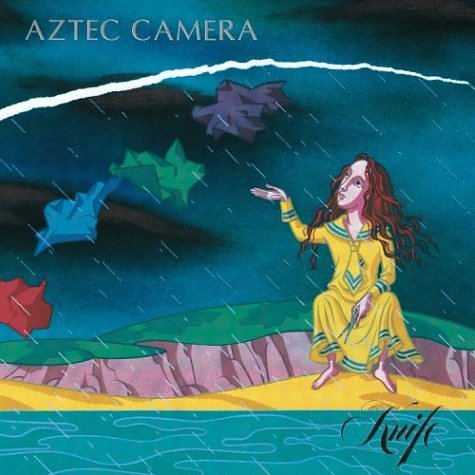 This is a wonderfully twisted covered of Van Halen’s “Jump.” VH’s version of “Jump” is bouncy, lively, fun, it makes you want to yes, Jump! It was many years after the release of VH’s “Jump” that I heard the Aztec Camera version (even though it was released the same year). The first time I heard it I assumed it was a joke.
I didn’t know much about Aztec Camera (and actually still don’t–looking at their Wikipedia page I don’t recognize the names of any of their singles). But I have grown to love this cover of “Jump.” In fact I prefer it to the original.
The opening chord structure makes me think it’s going to be the Rolling Stone’s “Waiting on a Friend” but instead of Jagger’s ooh oohs we get Roddy Frame’s deep voice practically whispering the lyrics that David Lee Roth made famous. And it stays with this delightfully mellow acoustic style and pacing throughout. The guitar work in the bridge is actually much more interesting than the bridge in the Van Halen version (ouch).
The chorus seems kind of odd with his very mellowly saying “jump” (although David Lee Roth doesn’t scream “jump” either, it’s the backing vocals that do the exciting part). I feel like the original VH version hasn’t held up that well, but the Aztec Camera version shows that it’s quite a good song.
Check it out here.
[READ: Week of November 8] Consider David Foster Wallace [first three essays]
I lied.
I said that I wouldn’t feel up to writing posts about all of the articles in this book on a regular basis. As it turns out, I don’t have a lot to say about these essays, but I had a few thoughts about each one. Since there’s a group reading going on, I thought it might be fun to post these thoughts now while people were still speaking about the articles instead of waiting until the end.
Before I say anything about this articles, I want to preface that I’m not going to repeat things that were said in the group read (for a couple of reasons). Everything here is going to be things that I felt about the article and maybe, if something another reader says really sticks with me, I’ll mention it as an influence on me.
Having said that, in one of the comments, author Clare Hayes-Brady says that her article is a part of a longer thesis. I found this to be a very useful thing to know, and I assume that she is not the only one who had to compress her article because of size and time constraints. With that in mind, I’m going to accept that if it seems like the author could/should say more about a certain thing within the article that there is probably a larger version of the piece.
And finally, because I don’t have a lot to say about the pieces, I’m only going to mention things that I found puzzling/confusing. But be assured that if I don’t mention the vast majority of the article it’s because I found it interesting/compelling/believable. I don’t feel comfortable paraphrasing the articles’ argument. Besides, what would be the point of that?
CLARE HAYES-BRADY-“The Book, the Broom and the Ladder: Philosophical Groundings in the Work of David Foster Wallace”
This article focuses on the Broom of the System and the impact of three philosophers on the book: Wittgenstein, Ricoeur and Rorty. I know a bit about Ludwig Wittgenstein and even less about Paul Ricouer. I’ve never read Richard Rorty. But I just read Broom, so it’s fresh in my mind.
I found the article to be reasonable, and compelling. But the one part that I had a question about/problem with was this (in the Wittgenstein analysis):
Lenore has to stabilize the set of features to which her name becomes the referent–i.e., she has to establish her Lenore-ness before the name will rest comfortably and the mystery of the whereabouts of Gramma Lenore, as Lenore Jr. significantly nicknames the older woman, can be solved. Important to note here is the fact that Gramma Lenore does not return to the narrative, leaving Lenore in sole possession of the title. It seems that Wallace will not allow his characters to appropriate terms they have not fully earned.
First, I’m not sure what is significant about the name Gramma Lenore. Further, if Gramma Lenore does not return to the text, how has Lenore Jr “earned” the title?
The rest of the article is convincing enough, but as I know there is more to the thesis than what’s here, I won’t go much further in my analysis.
GRAHAM FOSTER-“A Blasted Region: David Foster Wallace’s Man-made Landscapes”
This article looks primarily at Broom‘s G.O.D. (but also discusses IJ‘s Concavity) as man-made spaces. He explains how DFW inverts the typical American pastoral conceit of desert as pilgrimage. He also references Douglas Coupland as another author who talks about desert landscapes (especially Generation X).
My problem with this article is actually in the construction. I have written exhaustive papers for various classes over the years, and the first thing that was pounded into my brain was that your essay should always start with an introduction that tells exactly what you intend to do. You then demonstrate what you set out to do. Then you conclude by showing off how well you did what you did. Ta da. Nobody wants a surprised three-quarters of the way through the article with some new piece of information.
This article has no introduction. It begins by talking exclusively (and convincingly) about the G.O.D., but by the time he gets to IJ‘s Concavity (which has not been mentioned before the middle of the article), it seems to come out of nowhere.
As the article proceeds, he switches gears again and begins talking about the Eschaton map as a kind of man-made space. While I appreciate the connection, I’m not quite convinced that this is comparable with the G.O.D. and the Concavity. This may be a case of editing out a larger parcel, but I wasn’t really convinced by the argument. (The Escahton map hasn’t been “overtaken by commercial interest and the artifice of contemporary American culture” (although that is a very accurate quote about the G.O.D. and The Concavity).
As with the introduction, this article has no real conclusion, and actually ends with something that my professors would have taken a full letter grade off for: ending your article with a quotation from someone else. In this case, giving Chris Bachelder the last word. I’m also fascinated that Bachelder is listed as “arguably the closest we currently have to Wallace’s heir” which is something I’ve just never heard before (and which kind of comes out of nowhere).
On a more specific note, there’s a lot of typos (punctuation mostly) in this article, for whatever reason, but the one glaring detail error is that he refers to Lenore’s “parrot” which is clearly–and quite significantly–incorrect.
But the overall conceit about the G.O.D. and the Concavity is quite convincing.
CONNIE LUTHER-“David Foster Wallace: Westward with Fredric Jameson”
I’ve never read Fredric Jameson. I’ve also only read “Westward” once. I know I didn’t fully appreciate the story when I read it, so for this article, I’m going pretty much on evidence in the article.
And as such, it’s a pretty convincing case that DFW and Jameson have very similar attitudes about postmodern culture. The basis for much of this article is the by-now-oft-mentioned 1993 interview with Larry McCaffery which I regret that I have not read, (but feel I ought to because it seems so seminal to all of these papers–it has 15 mentions in the index!).
I have been listening to a lot of later interviews (ones that are freely downloadable online) and I felt that in these later interviews DFW’s take on postmodernism seems to be somewhat softer than in this early article. In the interviews that I’m familiar with he seems to want to correct errors of judgment about postmodernism, not to decry it outright. So it seemed like this article made DFW seem more strident than I have heard him speak. Nevertheless, the quotations from the McCaffrey interview certainly show DFW’s attitude as being much more negative and strident than the radio interviews I’ve listened to. So I have no real complaint in that context.
On a personal note, I feel that I have traveled a similar path as DFW w/r/t/ postmodernism and deconstruction. When I first read Derrida I quickly fell in love with the whole concept of deconstruction. I bought Glas just for fun. And if I am culturally correct, I believe that this infatuation came just before the massive rise of irony in the culture. Like DFW, I tried to immerse myself in this movement (although somehow I missed Don DeLillo and William Gaddis–I was more philosophy than literature at the time).
But as the time went on, I grew weary of the cleverness for cleverness’ sake and I now find a lot of that pomo attitude to be unreadable or certainly not really very fun. I still enjoy meta-fiction and in jokes but not at the expense of good storytelling and narrative. And I think that’s one of the reason why I like DFW so much.
So, yes, I was rather convinced by this article.
——–
I will try to keep up with the readings and offers some little comments as I go along. And I’ll try not to lie again.

 I Just Read About That...
Leave a comment