 SOUNDTRACK: BIG BLACK-Kerosene [live] (1990).
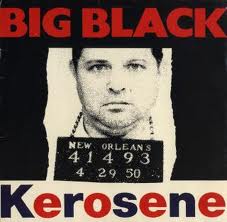 It never occurs to me to go looking for live versions of songs online, even though there are clearly thousands of songs I would like. So, I wait for them to come to me. My friend Andrew posted a video of this song. And it’s the first time I’ve seen Big Black live.
I’ve liked Big Black for a while (I got into them after they broke up). It’s not pleasant music by anyone’s standards, but there’s something visceral and unsettling about the lyrics and about Steve Albini’s guitar sound that I really enjoy.
I’ve seen pictures of Albini before, but I’ve never seen him in action, and I have to say, I can’t believe a guy as skinny and frankly, nerdy, as him is making sounds like this (although I can see someone like him being this angry). Watching him in this video is pretty great. He’s got huge glasses, his t-shirt is tucked into his pants–no that’s not right, it’s tucked into his guitar strap…how is he holding his guitar up??– and then he plays this guitar that sounds like, what…glass, needles, pins, shards of something, certainly.
And just when you think that the song is only noise, this fantastic bassline kicks in. The riff is outstanding: it’s heavy and propulsive and balances the sharpness of the guitar perfectly. In this version, about midway through the song he seems to be walking out into the crowd, and they sort of hold him up or push him back on stage, while he’s playing. And at the end, of course, he destroys the guitar.
Lyrically, it’s as disturbing as anything Albini has written, but man is it cathartic. And this live version is even more stark and brutal than the studio version.
[READ: June 2010 & October 12, 2010] “Extreme Solitude”
After reading “The Oracular Vulva,” I decided to re-read this, his recently published story. When this story came out in June, I heard that to some readers the main character reminded them of David Foster Wallace, and they speculated about whether or not this story was inspired by or a tribute to him. Unfortunately, I read that analysis before I read the story and it automatically influenced my reading (which if you haven’t read it I have now done to you, sorry).
I’m not in any way convinced that it is about him, although there are many similarities–size, athleticism, chewing tobacco, intelligence, semiotics. But since I know nothing about DFW personally and I don’t know if Eugenides does either, I won’t pursue that line any further. I will say that I didn’t find that train of thought terribly distracting while reading, though.
Anyhow, this story is about a senior in college named Madeline. Madeline was a good student and a good girl. She had dated some, but never had any crazy affairs (and was a bit uncomfortable when her roommate proudly wore (or displayed) her diaphragm–the joke about wearing it to an event is particularly funny).
By her senior year, after breaking of a long relationship with Barry, Madeleine was prepared to settle into her major: English. She was excited to read and to read a lot (it was her passion as well as her major). She also decided to sign up for a Semiotics class, which is where she met Leonard.
The description of the semiotics class is wonderful, from the pretentious students to the insanity of the class assignments–from Lyotard to Derrida and everyone in between, authors that I loved in college but since leaving academia I find so convoluted as to be kind of silly. I adored the sentence: “(Could “the access to pluridimensionality and to a delinearized temporality” really be a subject [of a sentence]?)”
And Madeline finds them puzzling as well, until she reads Barthes. Barthes speaks of love as extreme solitude. And this resonated with her as she felt so terribly alone while she was falling for Leonard but incapable of communicating with him.
When they finally do set a date, the phone conversation is a wonderful display of games, postmodernism and Fellini. It is fantastic. And their ensuing relationship is torrid and wild, full of unabashed abandon. Of course, once they start questioning each other, and really noticing their differences, things get a bit more complicated.
As the story ends, and they make an attempt to bring the passion back, semiotics returns. And the ending is harsh, brutal, very real and yet highly theoretical all at once. And the last line is very funny too. Eugenides makes a potentially alienating subject very enjoyable.
I rather wish I didn’t have so many other books to read, because I really want to start Middlesex soon, too.

 I Just Read About That...
[…] then they have a huge fight. The excerpt of the fight was published in The New Yorker (I reviewed it then). I loved it then and I enjoyed it even more with more context. When they break up, […]