 SOUNDTRACK: SUPERCHUNK-Laughter Guns EP (1996).
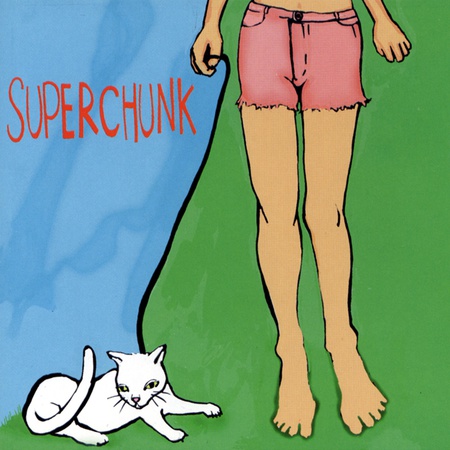 The first track “A Small Definition” is a surprisingly slow track from them. Even when the band kicks in about midway through, it’s still a fairly mellow sound And yet it is not a light track by any means. (A nice squalling guitar solo certainly helps.) But in case you thought the band had mellowed, track two “Her Royal Fisticuffs” brings back their punky bratty sound.
The third track, “The Mine Has Been Returned…” brings in a new sound altogether. It opens with a heavy heavy destorted bass riff (instead of the usual guitars). But the real surprise comes with the very distorted organ sound that throws the bass into sharp relief
The final song, “Hero,” is part surf rock part detective song, and continues the interesting departures that Superchunk explore on this disc.
And then there’s the bonus track. It’s a radio broadcast from WXYC a radio station in Chapel Hill. The track is a 42 minute deconstruction of “Hyper Enough.” It’s a few guys (and radio callers) dissecting the song in incredible detail. (hey listen to one verse about 20 times). The track starts about 20 minutes into the show, and they have just gotten past the first verse). At about 10 minutes into the track, the discussion turns into a fascinating look at deconstruction and the primacy of the author. There’s a caller’s snide comment that the band is all on crack and they should stop wasting their time–which of course, leads to a discussion of how drugs might impact the lyrics of the songs. It’s a crazy track and a crazy radio show. And shows how much fun college students can have when they really enjoy something. I listened to it when it came out, but haven’t listened to it again until this week. And I enjoyed it just as much this time. Perhaps I’ll try again in another 15 years. Oh, and until iTunes, I never knew the song was called, “Cool-Ass Mutherfuckin’ Bonus Track.”
[READ: October 1, 2010] “The Local Production of Cinderella”
Allegra Goodman was the next writer in the 1999 New Yorker 20 Under 40 issue.
The opening paragraph of this story confused me greatly. I wasn’t sure exactly what the author was trying to say. I re-read it three times, and then it finally clicked. And after that, the story flowed very nicely. The story is set in Hawaii in 1978. Two women, Roselva and Helen, have worked at the Hawaii Dept of Human Services at adjoining desks for years.
Roselva is Chinese-Hawaiian, very religious and a real believer in her job. Helen is of German descent and was born in Maine. She wanted out of human services.
As the story is being set up, we see that Roselva’s son’s fiancee is starring in a local production of Cinderella (I admit that the characters were a little hard to keep straight because, as we can see the titular character is actually several steps removed from the protagonists. We see some background–the young girl’s family doesn’t think that Roselva’s son is good enough for her, even though they have been engaged for some six years.
But Roselva’s attention shifts when she reads a letter that she finds in Helen’s outbox. It is a disturbing letter, addressed to the people of Hawaii which tells them to rise up against the white man who oppresses them. Roselva can’t believe that Helen would write this, and can’t imagine what she intends to do with it. But the more she obsesses over it, the more she thinks that maybe Helen is a prophet, that she has seen the future for Hawaiians. She doesn’t know how to react to this letter at all.
During the performance, her concern about Helen barely lets up. Although her almost-daughter-in-law really shines in the performance (but really what kind of future can she have?). The juxtaposition of graceful art and possible nervous breakdown built an interesting tension.
And the conclusion, although in many ways anticlimactic, was also surprisingly satisfying.

 I Just Read About That...
Leave a comment