 SOUNDTRACK: RAPEMAN-Two Nuns an a Pack Mule (1989).
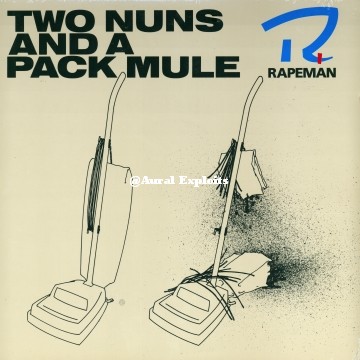 One of Steve Albini’s many groups, Rapeman made one album and an EP (both are included on the CD). Probably the most striking thing about this CD is Albini’s guitar which is so sharp it practically hurts (and when your guitar is more notable than the lyrics from a band named Rapeman, you know that sound is pretty striking). [You can hear hints of this sound on Nirvana’s In Utero (which Albini produced), particularly the screamy parts of “Scentless Apprentice”. The template is the same, although Nirvana’s drums are much much bigger. And, of course, Albini leaves the sonic edge really sharp for himself].
Although the guitar is what really stands out on this disc, the album would be far less interesting if the rhythm section wasn’t so strong. The bass is mixed really well, running lines that are never in concert with the guitar lines but which blend nicely and provide some needed low end. And the drums are sharp and punctuate the noise perfectly.
The opening of “Monobrow” is squeaks and feedback (I wonder if you could even write the music for it). When the rhythm kick in, it gives a herky jerky momentum. There’s an interesting twist on a song like “Trouser Minnow” which is written from a woman’s perspective (and yet she’s not an exemplary woman either) so you can read it a couple of ways. Of course, the opener, “Steak and Black Onions” is unequivocal: “Why don’t you snuff it man, you plant-eating pussy.”
But there’s definitely a sense of humor to all of this. In “Up beat” Albini gets angry and suggests that he’d beat a guy up. It ends, “I suppose I’m not too threatening presently. But wait till I start Nautilus.” There’s also something funny (I think) about them covering ZZ Top’s “Just Got Paid.” Funny or not, this version rocks like no one’s business, and it shows that Albini can actually play the guitar, not just make noise.
The Budd EP was recorded live. I love the description of the review here. It sounds less screechy (and more bass heavy), but no less menacing.
[READ: September, 16, 2010] The Wasp Factory
I bought this book many many years ago (I found a card in the pages from when I used to live in Brighton, MA (circa 1992) as a “bookmark.” But I think that the bookmark must have been not a real placeholder as nothing in the book was familiar, I just knew that it was supposed to be a dark, disturbing book.
And so it is.
The story concerns Frank, a 16-year-old who lives on an island outside of Scotland (my knowledge of Scottish geography is awful, so I don’t know exactly what he meant by an island, but suffice it to say that Frank’s family is isolated where they live). Frank is a disturbed individual. As the story opens, we learn that death and carnage follow Frank everywhere. In fact, Frank admits responsibility for three of these deaths.
Frank’s older male cousin, younger brother and young female cousin were all killed by Frank’s instigation (and direct participation), although all of the death’s could have been (and were) seen as accidents. The details of the these deaths come out slowly and reveal a devious but very clever mind at work.
Frank has an older half brother, Eric. Eric has just escaped from a mental hospital, where he was sent for, among other things, burning the neighborhood pets. Even though they live on an island, they are very close to a neighborhood with a pub and other amenities. So, again, geographically I’m a little confused, but it’s not really a big deal.
Frank is pretty much a loner, although he does have one friend; however, he almost never leaves the island (except to drink in the pub and to buy “supplies.”) But we learn that Frank’s father has never taken Frank in for any kind of tests. In fact, as far as anyone can tell, Frank does not “exist”–no social security number (the Scottish equivalent anyhow), and there are only a few people outside of the family who known the truth. Most people think that Frank is the nephew of Frank’s father.
Frank’s father is a fascinating character himself. A former scientist, he now mostly drinks and acts menacingly. He self-taught Frank, (obviously) and many of the lessons contained “jokes” that Frank didn’t know were jokes; mistakes that Frank learned about only through practical application. But most of the lessons were designed so that Frank memorized the arbitrary measurements of things in the house (size of the table, height of that picture and other bizarre things).
So, while Frank’s behaviour is abhorrent, the island upbringing wasn’t exactly stable either (we learn about Frank’s mother and her quick departure from their life). And we also learn the catalyst for Eric’s imprisonment. And this sequence is the most horrifying of the book–first just the scenario itself, but later when the truth comes to light it is pretty gag-inducing.
But what of Frank’s alpha maleness and simultaneous hatred of women?
The bulk of the story shows the outside environment that Frank has created: burial grounds for local animals, meticulously built dams which then get blown up ( and then drown the local miniature towns that were also meticulously created). And of course, the wasp factory itself. We don’t learn details about it until the very end of the book. And it is a fascinating (and of course, disturbing) contraption.
But nothing can prepare us for what is in Frank’s father’s study. The study is the one place in the world that Frank has no access to. It is always locked. Always. As with any story, we know that at some point Frank will get into the study. And the contents of that room change everything.
This book is not for the weak of stomach. And even after 25 years, it is still shocking. Although I feel compelled to say that it is not terribly graphic. Unlike say, American Psycho, which revelled in the brutality and detailed descriptions of violence, The Wasp Factory is a more subtle violence (which may be worse, actually). Of course, some bits are brutal (the rabbit scene is pretty horrible) and, obviously, any creature set on fire can’t be described without some grisly details.
But there is still humor in it (Frank’s father’s ability to tell what Frank has drunk that evening by smelling his farts is delightfully rude). Nevertheless, this book is not for everyone. But if you’ve the stomach, there’s surprising satisfaction in it.

 I Just Read About That...
[…] I Just Read About That,,, […]