 SOUNDTRACK: LUTHER WRIGHT AND THE WRONGS-instrumentality (2006).
 I loved Luther’s Rebuild the Wall, and I kind of thought of him as country, but not really country. A sort of punky country (his song “Broken Fucking Heart” lead me in that direction, too).
But this album is all instrumentals (hence the title) and it’s very traditional bluegrass/banjo-fueled tracks. Eleven tracks in all (totaling about 22 minutes). There’s even a cover of “Yankee Doodle Dandy.” Listening to this I realized that I like banjo music (not as my favorite type mind you, but certainly more than a little). Steve Martin (an excellent banjoist himself) once said:
“You just can’t sing a depressing song when you’re playing the banjo. You can’t go– [grins, plays and sings] “Oh, murder and death and grief and sorrow!”
And there’s something to be said for that. With this fun collection of mostly 2 minutes songs, you’ll smile for twenty minutes or so. (And the playing is top notch, too).
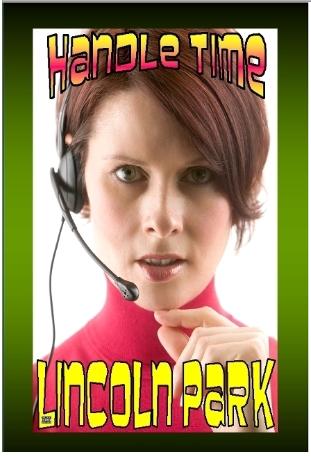
[READ: September 11, 2010] Handle Time
When I wrote about One Night @ the Call Center, several readers said I must read Handle Time, that it was the consummate Call Center novel and that it was much better than One Night. So I tried to find it. No libraries in New Jersey carried it. And although I could get it at Amazon, there was precious little other information about it. Well, I finally decided to add it to our library collection (so I didn’t have to pay for it) and to read it for myself.
My first surprise came when the first line of the text has the word embarrassed written in a super large font. The font is so large in fact that it put a pretty sizable space between the lines of text (that’s called leading). My second surprise came when I saw that littered throughout the text were a whole bunch of large words and crazy fonts and a bunch of clip art pictures that showed what was happening. (I was especially surprised when one of them turned out to be Mr Burns from The Simpsons!).
So it turns out that there are different fonts throughout the book, some of them large and crazy, others fancy and scripty. But the long and short of it is that this book is really only about 50 pages long (I mean I read the entire 188 pages in about 2 hours).
Okay, but what about the content. Well the plot itself is fairly brief. Chase gets a job at a call center. She sits through orientation, begins working, gets demoralized and has a panic attack about her job. That’s pretty much it. But really what you read the book for is for the side bits, the comments, the snark, the sympathizing with call center workers.
Except that I’ve never worked in a call center and yet I have experienced many of the things in the novel. So, this book, much loved by call center workers, could be about pretty much any shit job (except for the part about keeping your numbers up (and the part about not actually helping people because it skews your average handle time)). But bad cafeterias, microwaves, bizarre HR nonsense, stupid powerpoints, they’re part of any corporate job. And she does a good job in skewering them, they’re just not specific to call centers.
The thing that really threw me off was that after the opening chapter which sets up the plot about Chase, the book jumps right into a very lengthy (almost half the book) tirade about training and learning to do the job and coworkers. It’s quite amusing, especially once you recognize the types she’s talking about. [Bathroom breaks was particularly funny as was the bit about naming conference rooms]. But by the time she got back to the plot I had forgotten there even was a plot to return to.
Basically this book felt like a pretty funny series of blog posts (especially since there are lots of asides with LOL written after them: “Sounds just a little freaky deaky doesn’t it? LOL.” (56). Perhaps it was initially a blog about a crappy job with all kinds of details and axes to grind. And it must have been very satisfying to write.
The one major gripe I have with the book is a decision the author made that I find oddly cheesy: despite the Simpsons picture in the early pages, whenever she references an actual online entity, she changes the name ever so slightly. So we get things like Pagespace, Yourspace, Facespace and Bidbay. I’m not sure why you would bother doing that, when those are all public entities. Of course, the most egregious was mocking Office Space but calling it Cubicle. [Okay it is kind of funny, but she seems largely opposed to the movie and this book is more of less a list version of the movie, so that’s not cool]. I just think you could get more laughs by using the real names.
Oh and speaking of the real thing, this book seems to have been written (at least in part) in response to One Night @ the Call Center as there is section about Indian call center workers and a specific comment about the “35=10 axiom” from that book. I can’t help but wonder if she read that book and felt the need to write the American version.
But, overall, this was a fun little book. I laughed in recognition at a lot of things and generally enjoyed it. It was a fast read and a good diversion.
If I was irritated by the design of the book quite a lot (although again, if it were a blog, I think the photos would work nicely). And really in no way would I call this a novel. It’s more of a humor book with a side plot thrown in.
On Lincoln Park’s blog you can read her entire first novel (which is very nice of her) and that one uses only one font and rolls in at around 145 pages (I haven’t read it though). So I assume all of this font and design business was deliberate for this book. I’m not sure what it brings to the story except padding, but hey who doesn’t love pictures in a book?

 I Just Read About That...
Leave a comment