 SOUNDTRACK: MASTODON-Leviathan (2004).
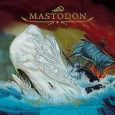 This is the CD that started it all. Well, for me and Moby Dick- related music, anyhow. My friend Andrew asked if I would be reviewing it along with Moby Dick. And, yes I am.
Leviathan is sort of a concept album about Moby Dick. I say sort of because it’s not entirely about Moby Dick. The opener, “Blood and Thunder” features the chorus: “White Whale. Holy Grail. And it also features lyrics that seem to come straight from the book: “break your backs and crack your oars, men.” There’s also the tracks “I am Ahab” and “Seabeast,” the latter features the lyrics: “Dear Mr Queequeg you have been informed your life’s been saved”
And yet, not everything is about Melville’s saga: “Island” bears no resemblance that I can see and the final track, a slow instrumental is called Joseph Merrick (who was the elephant man).
Musically the disc runs from bludgeoning metal (“Island”) to complex and intricate bludgeoning metal (“Iron Tusk,” which features a stereophonic drum solo opening). “Blood and Thunder” has some great catchy riffs with some vocals that demand a lyric sheet for clarity. “I am Ahab” features some extended vocal notes! But there’s more to it than that. “Seabeast” has a great slow intro guitar solo and features a two different vocalists to very good effect.
And the whole disc is chock full of time changes, crazy drum fills (how can he play so many different drums so quickly?). “Megalodon” has a great odd guitar riff in the middle break section (and has nothing to do with Moby Dick at all).
As you near the middle of the album you get a couple of amazingly complex tracks. “Naked Burn” features a great melodic middle section (coupled with really catchy vocals, too). And the highlight is the thirteen plus minute “Hearts Alive.” It begins as a very pretty acoustic guitar piece. After about two minutes the heavy guitars kick in and there’s several different middle sections with varying degrees of melody. By the midway point we’ve heard a few more very beautiful picked guitar sections, until it ends with some strong heavy guitar chords that slowly fade away.
So it’s a super heavy progressive rock/speed metal concept album for people who don’t like real concept albums (but who like their metal literate). Who would have guessed it would have made so many best of the year lists?
[READ: Week of June 28, 2010] Moby-Dick [Chapters 111-End]
The end is here and BOY did I not see that coming. I honestly had no idea how the book ended (how is it I knew the basics of the story but didn’t know the ending? Talk about everyone agreeing to the spoiler alert!). The other thing that surprised me was how damned exciting those last 70 pages were. Now it could be a simple build up from the slowly paced early chapters–we were all lulled by the waves and the diversions–but man, when Melville wanted to, he produced the goods. If you want young people to read this book, just assign them the last 70 pages. I realize that all the art and such will be lost, but if they read just the end parts, they’ll come away with a much better perception of the book, and maybe they’ll want to read the rest later. [I’m not a fan of abridged things of course, so I’d want them to read the original full text, just the end of it].
And I absolutely cannot believe [spoiler alert–okay the whole post is a spoiler, even if I didn’t know, the book is over 150 years old, so chances are you may have heard…]
that Queequeg dies! After all the buildup and love and brotherhood and Siamese-twinness? Wow. The story is now almost a tribute to Queequeg (except that we barely hear of him since his final big coffin scene. He barely even gets a mention as the ship goes down).
So the reading opens with a big section about Perth, the blacksmith. It’s pretty late in the game to give a detailed biography of a new character (something which DFW does in IJ as well), but that’s okay. We learn that Perth was a respected blacksmith with a loving family. And his hammer clanged mightily and continually. But then he found trouble And I really loved the way Melville describes his downfall, it is the most poetic description of alcoholism I can recall:
But one night, under cover of darkness, and further concealed in a most cunning disguisement, a desperate burglar slid into his happy home, and robbed them all of everything. And darker yet to tell, the blacksmith himself did ignorantly conduct this burglar into his family’s heart. It was the Bottle Conjuror! Upon the opening of that fatal cork, forth flew the fiend, and shrivelled up his home (480).
So, he lost his livlihood and his family, and his last recourse was to set sail.
On board the Pequod, he has been tasked to do many things. Ahab asks him if he can fix anything and everything. Perth says all but one. And when Ahab asks him to smooth the wrinkles on his face, Perth says that that is the one thing he cannot do (more poetry!).
Nevertheless, Ahab calls upon Perth to make the sharpest harpoon ever. Perth agrees; he works hard and adds all kinds of things like horse shoe stubbs and Ahab’s own razors. And after Perth has fired and flattened it to a point, Ahab does not want it cooled in water, rather, he asks for the blood of savages: Tastego, Queequeg and Daggoo. They offer their blood for Ahab to cool the metal. And, in what must have been shocking then and which was surprising to me given the religious nature of the book, Ahab baptizes the harpoon in the name of the devil!
“Ego non baptizo te in nomine patris, sed in nomine diaboli!” (Norton Critical translates it: “I do not baptize you in the name of the father, but in the name of the devil” (Norton, 404).
Aside from a really weird sentence that I cannot fathom (“I am Stubb, and Stubb has his history; but here Stubb takes oaths that he has always been jolly!” 487), the story moves on to the next ship that they meet: The Bachelor.
In previous posts I have mentioned that there seems to be a bit of nudge nudge wink wink with regards to the use of the word sperm. And it seems to me that this chapter is one of the best examples. So, the boat is called the Bachelor, and we get this outrageous description:
In the forecastle, the sailors had actually caulked and pitched their chests, and filled them; it was humorously added, that the cook had clapped a head on his largest boiler, and filled it; that the steward had plugged his spare coffee-pot and filled it; that the harpooneers had headed the sockets of their irons and filled them; that indeed everything was filled with sperm, except the captain’s pantaloons pockets, and those he reserved to thrust his hands into, in self- complacent testimony of his entire satisfaction (488).
Sounds like a bachelor to me. And in a book about omens, this is the final instance of good luck out on the sea. And good luck seems to be directly tied to knowledge (or really lack of knowledge) of the white whale. So when Ahab asks this hugely successful ship if she has seen the white whale
“No, only heard of him; but don’t believe in him at all,” said the other good-humoredly (489).
So yes, ignorance is bliss and possibly success. Although the next chapter shows that the Pequod did catch 4 more whales in short order. (Has anyone bothered to keep track of just how many whales they get?).
Of course this doesn’t satisfy Ahab at all. And he has a chat with Fedallah, who gives him very specific portents that he must look for before his doom: Ahab will see Fedallah once after his (Fedallah’s) death and that Ahab will only die by hemp (which Ahab assumes is the gallows).
Now Ahab is really starting to lose it at this point. He smashes his quadrant–calling it a fool’s toy–and then, in the next chapter, when the storm comes, Ahab refuses to take any precaution (lightning rods and all that). Starbuck notes (how many omens can there be in this book?) that the storm is coming from the East where Moby Dick is, and if they look west back towards home, the skies are clear and the wind would be at their back the whole way.
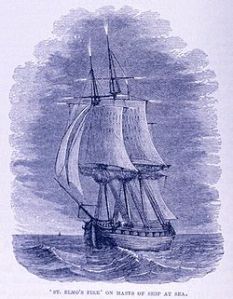 Then the typhoon hits them and the ship has corpusants–which I had to look up, and which means St. Elmo’s Fire. I am fascinated that this bizarre phenomenon has a term.
Stubb (ever the optimist) takes the fire shooting off the masts as a good sign–the three masts are like wicks for all of the sperm they will be carrying. Starbuck sees things very differently, but before he can get anyone riled up, Ahab grabs his harpoon (which also has flames coming off of it!) and silences everyone.
Later that night Starbuck tries once again to convince Ahab to give up. (It doesn’t work). And then later, when another crisis has arisen, Starbuck heads to the captain’s cabin with the intention of waking him. But Starbuck has a moral dilemma when he sees that captain’s musket: he could kill Ahab right now and sail the boat home. It’s the very musket that Ahab surely would have killed him with if he had the chance. And Starbuck ponders this for quite sometime before fleeing back above ship.
The crisis is that the ship’s compass has has its magnetic polarity reversed by the storm (oooh, shame about that quadrant that you smashed). Ahab orders them to steer by the reverse direction that the compass is pointing (another bad omen). But soon enough Ahab is able to work some kind of magic on a piece of metal
going through some small strange motions with it – whether indispensable to the magnetizing of the steel, or merely intended to augment the awe of the crew, is uncertain – he called for linen thread (511)
which creates a new compass needle!
We get some more insanity in Chapter 125 as Pip resurfaces. Pip speaks of Pip as another person entirely, he’s clearly gone mad (although it took me at least two reading to determine this):
“Pip? whom call ye Pip? Pip jumped from the whale-boat. pip’s missing. let’s see now if ye haven’t fished him up here, fisherman. It drags hard; I guess he’s holding on. Jerk him, Tahiti! Jerk him off; we haul in no cowards here. Ho! there’s his arm just breaking water. A hatchet! a hatchet! cut it off – we haul in no cowards here. Captain Ahab! Sir, Sir! here’s Pip, trying to get on board again” (514).
Ahab sees a kindred spirit in this deluded boy and for much of the rest of the book, they are inseparable. Ahab even takes Pip along with him to his cabin.
The crew then hears seals out in the water. They sound an awful lot like humans in distress. And in the confusion, the ship loses the life buoy. What could they use for a replacement? It needs to be about 6 feet long, slender, kind of coffin shaped. Queequeg’s coffin is called into use, and the carpenter (grumbling at having to change his beautiful work) sets out to sealing it up and making it watertight.
The next ship they meet is The Rachel. And here begins the slide into portents of doom. The Rachel is the inverse of The Bachelor, she is not cheerful, not sailing in high spirits. Ahab asks if they have seen the White Whale, which they have, just yesterday in fact. But the Rachel has more pressing needs. They have lost a boat and they are searching the waters meticulously.
They ask if they can borrow the Pequod for just two days to that they can search together for their lost crew. Ahab refuses, of course. And then the commander breaks down and reveals that one of the lost sailors is his own son, only 12 years old, on his maiden voyage. The captain had to make the untenable choice of which son to rescue. Both sons were in boats when disatster struck and he was forced to rescue t he boat closets to the ship (which contained his older son), leaving his youngest sin to flounder in the water.
The Pequod crew mutter to themselves about all of this. At first Stubb wants to bet that the reason that the Captain is searching so diligently is because he left his best coat in the boat. Of course when he hears the truth his tone changes. But at the same time the crew knows that there’s really no hope for the boy. And yet, how could you deny this request?
Ahab finds a way! In fact, Ahab doesn’t even consider it. And the crew of the Rachel watch, with jaws on the floor as the Pequod pulls away.
Soon after, the Pequod encounters the Delight (the most ironically named boat thus far). The Delight has seen the white whale and the captain believes that the harpoon has not been forged that will kill the beast. But there is no jest in his speech for he is presently lowering his dead crew into the water.
All of these chapters have been pretty short up till now, and we get one final calm before the storm. Ahab thinks back about his life on the sea. And at one point we learn that Ahab is 58. That seems younger than I think he is often depicted, although realistically he couldn’t be much older than that in 1851. And, I suppose 58 years as a sailor and a whaler must take its toll on a man. Ahab and Starbuck discuss their families back home. After all of their friction, the share a rather touching moment together.
But after the moment of reflection, as night fades away, Ahab picks up the whale’s scent. He tells the crew that it will be he, Ahab!, who will spot the whale first and he who will get the dubloon. And so it is true. And for a few pages we watch the sailors watch Moby Dick in the distance, spouting and breaching, a creature that fills them with awe.
And so begins the first day of the chase. Soon, they lower boats and set sail for the target. As they close in on the whale, he dives. And, in a passage that I found incredibly hard to understand (even after 3 reads) I’m gathering that Moby Dick dives down to the depths and then rises straight up at Ahab’s boat. Ahab tries to turn the boat out of the way, but Moby Dick repositions and catches Ahab’s boat in his fabled jaw. The boat is destroyed in an instant, but luckily everyone is spared. Moby Dick swims away intentionally splashing his tail to cause more disturbance to Ahab. The Pequod placed itself between the whale and the boats and the rescue began. The day ends, Ahab is worn out from the hell. The first day of the chase is over, but Ahab knows where he’s headed. They sail through the night (even though they can’t see him) and use Ahab’s sixth sense for where he will surface in the morning.
The second day they regain the whale. They spot Moby Dick early, but it proves to not be the white whale. Ahab has a fit but then resumes his post and once again actually spies the whale. And despite, or maybe because of what happened yesterday, the crew works together as one to get revenge on the beast. They put three boats in the water.
This time Moby Dick charges straight at the central boat helmed by Ahab. He cheers them on saying he will take the leviathan head to head. The whale charges and Ahab readies his harpoon. But Ahab realizes that all of the lines and loose weapons are tangled in a big heap and attached to the whale as well. Ahab must cut the steel to retrieve spare the dangerous mess and he sends this whole thing splashing overboard.
Meanwhile, the whale roundabouts and smashes Stubb’s and Flask’s boats together reducing them to planks. And in the confusion of the crews trying to stay alive, MOby Dick strikes Ahab’s boat with his forehead, sending everyone ass over tea kettle into the water.
The Pequod sails over to rescue the crew. All are accounted for. Expect where is Fedallah? The crew determines that he was caught in the line that Ahab threw overboard. Ahab is distraught. He doesn’t even seem to care that his ivory leg has been smashed. But he is determined to press on. And, in a simple quote showing darkness vs light, Starbuck pleads:
“never, never wilt thou capture him, old man – In Jesus’ name no more of this, that’s worse than devil’s madness. Two days chased; twice stove to splinters; thy very leg once more snatched from under thee; thy evil shadow gone – all good angels mobbing thee with warnings: – what more wouldst thou have? – Shall we keep chasing this murderous fish till he swamps the last man? Shall we be dragged by him to the bottom of the sea? Shall we be towed by him to the infernal world? Oh, oh, – Impiety and blasphemy to hunt him more!” (553).
But I think when you baptize your harpoon in the name of the devil you’re not too concerned about impiety.
And so ends day two of the chase.
The third day proves be the last one. And things look grim from the outset: it’s noontime and they still have not spotted the whale. And as late afternoon approaches, Ahab spots his prey. Before he puts the boat in the water he takes one lat look around the ship and all that she has done for him. It’s like he knows he will never return to her.
Ahab puts his boat in and sharks are swarming. Every time Ahab puts an oar in the water it is attacked by the sharks. But he presses on and as he raises his harpoon, the whale
showed one entire flank as he shot by them again; at that moment a quick cry went up. Lashed round and round to the fish’s back; pinioned in the turns upon turns in which, during the past night, the whale had reeled the involutions of the lines around him, the half torn body of the Parsee was seen; his sable raiment frayed to shreds; his distended eyes turned full upon old Ahab (560).
So there’s Fedallah’s first prediction come true: “Aye, Parsee! I see thee again. – Aye, and thou goest before; and this, this then is the hearse that thou didst promise” (561). I had a harder time understanding the second prediction. Even when it comes true a few paragraphs later, I’m not really clear what happened. Ahab notes: “But I hold thee to the last letter of thy word. Where is the second hearse?” (561).
The whale, after three days and several harpoons seems to weaken some, and he actually seems to be backing down from the fight a little. So Ahab pursues and launches yet another volley at him. Moby Dick, seemingly confused, mistakes the Pequod for Ahab and charges the giant ship. The crew sees the approaching whale and they take places in preparation.
The White Whale rams the ship and the entire crew knows that it’s over for them. They quickly try to able water and heal flaws, but it is of no use and the Pequod sinks straight down. It’s at this point that Ahab shouts: “The ship! The hearse! – the second hearse!” cried Ahab from the boat; “its wood could only be American!” (565). I’m note entirely clear about this hearse business, but I think I’m getting it on this last re-read.
It’s only time for one last prediction: the hemp. AS the whale takes another harpoon, he darts away, and
with igniting velocity the line ran through the groove; – ran foul. Ahab stooped to clear it; he did clear it; but the flying turn caught him round the neck, and voicelessly as Turkish mutes bowstring their victim, he was shot out of the boat, ere the crew knew he was gone. Next instant, the heavy eye-splice in the rope’s final end flew out of the stark-empty tub, knocked down an oarsman, and smiting the sea, disappeared in its depths (565).
The rest of the crew has nothing left to do but wait for death.
Yes everybody is dead.
So how could the Epilogue have been left out of any publication of the book? I mean any half way intelligence reader would have said, if everyone died how could Ishmael have told the tale?
And the Epilogue is a masterful piece of writing that ties in so many narrative threads in one paragraph that it is incredible.
Ishmael is saved by Queequeg’s coffin/life-buoy, and on the second day his is rescued by The Rachel, which in another wonderfully poetic touch, has “only found another orphan” (567).
COMMENTS
I was delightfully surprised with how much I enjoyed the ending of this book. It was really masterfully crafted, with so much introspection mixed with action. And the action was really something. (True the language did get in the way of a few details for me…I had to read twice about what actually happened to the Pequod…but I was still blown away.
And, to have the whole crew dead! My goodness. That just seems to change everything that you’ve read so far. It’s fantastic.
I’m planning to write a summary/round up of the book in a day or two when I can process everything. But until then, consider my mind blown.
The one thing I’m unclear about–did Moby Dick die? I’m thinking not.

 I Just Read About That...
Though we think of a hearse as a particular type of wheeled vehicle, I think it’s just the name for some conveyor of the dead. Thus Moby Dick is a hearse for Fedallah and the Pequod is a hearse for the crew that remains aboard.
Of course we can never know whether or not Moby Dick dies. Like you, I tend to think he doesn’t.
Lots of British critics (the epilogue did appear in the American edition) scoffed at the narrative problems that arose from the fact that the epilogue was missing, puzzling over how Ishmael could tell the story if he died along with the crew.
Your surprise at the death of Queequeg is certainly reasonable. Those who propose that Moby-Dick had several phases of composition have suggested that Queequeg may have been the original hero but that the direction Melville decided to take the story ruled out that ending, so that Queequeg had to go down with the ship as well.
Seen as an allegory of the America of the time (30 men federated along one keel, Melville describes the Pequod at one point), this is a pretty bleak ending, huh?
Another epic post. Can’t wait to see what you write up for IZ. I’m really glad you liked the book.
[…] about omens in the book, but that has been well covered by Daryl (I do have some specific omens in this post). And finally I considered revisiting religion since Ahab has the audacity to baptize his harpoon […]