 SOUNDTRACK: THE DECEMBERISTS-“The Mariner’s Revenge Song” (2005).
 This was the hardest week for music tied to Moby-Dick. (I’m saving Mastodon for the grand finale). I don’t really have anything that relates directly to the book. I have a number of nautical-themed songs, but very little in the way of albums. And, it’s true that this song doesn’t have anything to do with Moby-Dick directly.
However, it’s a 9 minute song about a mariner getting swallowed by a whale just for revenge. So, it’s sort of related.
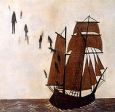 The Decemberists are one of your more nautical bands (and I’ve reviewed all of the albums here somewhere). Their first album, Castaways and Cutouts featured an album cover with a ship with ghosts drifting from it.
This song has an accordion fueled shanty feel as we follow the tale of a young lad who seeks revenge on the rake who used and abused his mother and left her a poor consumptive wretch. After fifteen years, he finally hears tale of the rake–he’s now a captain at sea.
So the lad hires on with a privateer and hunts down the captain’s ship. As he is about to fire muskets upon him, a giant whale crashes on their ships, swallowing the two men whole (tell me, Ishmael, what kind of whale might do that?).
And it’s from inside the whale the we hear this tale. The lad’s mother’s dying words echoing among the ribs of the beast:
“Find him, bind him
Tie him to a pole and break
His fingers to splinters
Drag him to a hole until he
Wakes up naked
Clawing at the ceiling
Of his grave
*sigh*”
And it’s catchy as all heck, too!
[READ: Week of June 21, 2010] Moby-Dick [Chapters 87-110 ]
Pirates! I didn’t expect pirates in the book. Week 5 opens with Ishmael discussing pirates in the low shaded coves of Sumatra. Ahab intends to sail right through those piratical waters to get to Java because sperm whales are known to frequent the area. And indeed they do. A whole fleet of sperm whales is seen but at about the same time, the pirates come out and give chase. My notes in the margins are a little diagram of a fleet of whales with an arrow and then a tiny Pequod and another arrow and then a jolly roger.
The Pequod easily outruns the pirates and still manages to keep the whales in sight. So, they jump into the fray and start harpooning away. However, as the saying goes, “The more whales the less fish” (389).
After a whale is hit, it takes off speeding through the rest of the whales and dragging the ship with him. The boats finds itself in the middle of the armada of whales, but there is much distress. It turns out that the thrashing whale is impaling the other whales in the fleet. There are many wounded whales lolling in the sea. The Pequod uses druggs (which others suggest might be drogues) to “claim” these whales. But with all the trouble and excitement, the Pequod manages to get only one whale.
Oh, and when I called the whales a fleet, we all know they are actually schools, and when a school of females is escorted by a male, he is called the schoolmaster. We get a few randy comments about schoolmasters, as well as some observations about whale sex, but I’ll leave that for Melville. [A recent nature show we watched, possibly Life, showed bull whales jockeying for position with females. It was pretty fascinating, and Melville is pretty spot on].
When the Pequod claimed (drugged) some of the dead whales, it was noted that there are some unstated rules about whaling and the ownership of dead whales. And the terms used are Fast-Fish and Loose-Fish. And the official rules are:
I. A Fast-Fish belongs to the party fast to it.
II. A Loose-Fish is a fair game for anybody who can soonest catch it (393).
A Fast fish is attached to the ship or has any other symbol of ownership (the druggs) on its person (whaleness?).
Ishmael then goes back fifty years into a historical case about proper ownership of whales. Ship A had chased down a whale and in the process of securing it, destroyed its ship. But they hung around by the wreckage and the whale. While everyone was sort of floating around, Ship B came, took the whale and all of its contents and essentially gave the Ship A the finger. When taken to court, the judge let the Ship A keep their ship, but as for the whale, since it was not held fast to a boat, it was given to Ship B.
This idea of ownership of whales actually goes even further back than that. Heads of state often claimed all of the parts of whales for themselves:
In a word, the whale was seized and sold, and his Grace, the Duke of Wellington received the money….
“But the duke had nothing to do with taking this fish.”
“It is his.” (335)
Ishmael goes back even further to the idea of Loose-Fish–which is anything not attached to a boat or laid claim to in some way–“What was America in 1492 bit a Loose-Fish?” (334).
The next ship the Pequod encounters is The Rose-Bud. This is a fairly humorous anecdote. The Rose-Bud is manned by a French crew (with but a few speaking English). The captain is a complete novice. They had two whales strapped to their boat and boy were they smelly. The wind had died down so it was just the odor and the ships.
Ahab asks if they have seen the white whale–Cachalot Blanche–but no, they have not. Exit Ahab, but enter Stubb with a very cunning plan. The long and the short of it is that Stubb convinces the captain and crew of the Rose-bud that neither of the whales is going to give up anything useful, and they’d be best off getting rid of them. The mate also wants both of the whales gone, so Stubb makes up some nonsense and has the mate “translate”
“Why,” said Stubb, eyeing the velvet vest and the watch and seals, “you may as well begin by telling him that he looks a sort of babyish to me, though I don’t pretend to be a judge.”
“He says, Monsieur,” said the Guernsey-man, in French, turning to his captain, “that only yesterday his ship spoke a vessel, whose captain and chief-mate, with six sailors, had all died of a fever caught from a blasted whale they had brought alongside.”
Upon this the captain started, and eagerly desired to know more.
“What now?” said the Guernsey-man to Stubb.
“Why, since he takes it so easy, tell him that now I have eyed him carefully, I’m quite certain that he’s no more fit to command a whale-ship than a St. Jago monkey. In fact, tell him from me he’s a baboon.”
“He vows and declares, Monsieur, that the other whale, the dried one, is far more deadly than the blasted one; in fine, Monsieur, he conjures us, as we value our lives, to cut loose from these fish” (405).
The captain, who doesn’t know anything, willingly agrees and they set the whales loose. The captain is so appreciative of the information, that he offers Stubb a drink to which he replies:
“Thank him heartily; but tell him it’s against my principles to drink with the man I’ve diddled. In fact, tell him I must go.” (405).
Stubb is pretty excited: he sneaks the Pequod betwixt the Rosebud and the whale and then proceeds to extract the whale’s ambergris. Ambergris is the substance they make perfume out of and is quite valuable.
And then we meet a character that we’ve really only heard about briefly. This would be Pip. Pip is the ship’s ship-keeper, a sort of errand boy left on ship while the men do the real work. There’s a few choice words about Pip’s “tribe” and how they celebrate every day like the 4th of July, but that’s neither her nor there. The meat of the Pip chapter is that Pip is called on one of the boats while Stubb’s oarsman has sprained his wrist.
I can’t decide if this is meant to be comic or not, as it’s not quite s broad as some of the other chapters, and there appears to be real danger involved. But we’re given the set up that Pip is pretty clumsy. Cut to Pip getting tangled up in the harpoon rope and getting hurled overboard. The boat must cut free the line to save him. And when he gets back on board he gets a severe tongue lashing. He’s told in no uncertain terms that is he falls overboard again, he will be left in the water.
Then “Whale Ho!.” Cut to Pip falling into the water again This time he was not tangled in the rope, so the boat did, in fact, leave him to bob in the water. Ishmael lets us know that Stubb didn’t really abandon the poor boy, that any of the other boats would surely pick him up. However, those boats spied whales before they spied Pip and they took off in other directions. Pip was left in the water for ages. And really who knows what his fate is meant to be. Eventually the Pequod spies him and brings him back on board.
The next scene is a strange one even for this book. It details Ishmael’s dreamlike state as he and his shipmates squeeze sperm:
Squeeze! squeeze! squeeze! all the morning long; I squeezed that sperm till I myself almost melted into it; I squeezed that sperm till a strange sort of insanity came over me; and I found myself unwittingly squeezing my co-laborers’ hands in it, mistaking their hands for the gentle globules. Such an abounding, affectionate, friendly, loving feeling did this avocation beget; that at last I was continually squeezing their hands, and looking up into their eyes sentimentally; as much as to say, – Oh! my dear fellow beings, why should we longer cherish any social acerbities, or know the slightest ill-humor or envy! Come; let us squeeze hands all round; nay, let us all squeeze ourselves unto each other; let us squeeze ourselves universally into the very milk and sperm of kindness. Would that I could keep squeezing that sperm for ever! (415).
I can’t say I know anything about whale sperm, but I’m not sure what this account is all about (aside from the nice, peaceful wishes). But before we get too high on this part, Ishmael talks about some other interesting whale substances. White-horse, plum-pudding, slobgollion (possibly slumgullion), gurry, nippers. And while we’re looking at fascinating things about the whale, let’s discuss his “cassock” you know, the cassock* [*My edition is thoughtful enough to tell me that this is the whale’s penis]. One of the mincer’s jobs is to cut the cassock lengthwise and remove the pelt. This is turned inside out and he slips it on like a poncho.
Getting back to the ship itself, he investigates the “try-works.” They are a kind of fat burning furnace which smokes like the dickens. The ship is overcome by the thick black smoke, which you can’t escape. But the blubbery smoke has a strange effect on Ishmael:
But that night, in particular, a strange (and ever since inexplicable) thing occurred to me. Starting from a brief standing sleep, I was horribly conscious of something fatally wrong. The jaw-bone tiller smote my side, which leaned against it; in my ears was the low hum of sails, just beginning to shake in the wind; I thought my eyes were open; I was half conscious of putting my fingers to the lids and mechanically stretching them still further apart. But, spite of all this, I could see no compass before me to steer by; though it seemed but a minute since I had been watching the card, by the steady binnacle lamp illuminating it. Nothing seemed before me but a jet gloom, now and then made ghastly by flashes of redness. Uppermost was the impression, that whatever swift, rushing thing I stood on was not so much bound to any haven ahead as rushing from all havens astern. A stark, bewildered feeling, as of death, came over me. Convulsively my hands grasped the tiller, but with the crazy conceit that the tiller was, somehow, in some enchanted way, inverted. My God! what is the matter with me? thought I. Lo! in my brief sleep I had turned myself about, and was fronting the ship’s stern, with my back to her prow and the compass. (422).
And the moral he gives us is:
believe not the artificial fire, when its redness makes all things look ghastly. To-morrow, in the natural sun, the skies will be bright; … the glorious, golden, glad sun, the only true lamp – all others but liars! (422).
Of course, this is nothing compared to the joy of the Lamp (a chapter three paragraphs long). Whalemen are some of the few sailors who get to burn pure unadultered sperm oil.
Now with all of this blood and oil and fitlh onboard, the whale ship must be disgusting, no? Indeed not. For sailors do their utmost to ensure that the ship is clean and sparkling. And they will spend nigh on many hours ensuring the cleanliness of the ship. And then “There she blows!” off the side of the boat and get the whole ship filthy again. “Oh! my friends, but this is man-killing! Yet this is life” (426).
And remember that doubloon, the promise that Ahab gave to all the sailors upon capture of the white whale? Well, the sailors remember it too. Ishamel gets into an omniscient narrative point of view as he relates what some of the other sailors whisper to the doubloon: Ahab philosophizes about it; Starbuck, ever critical of Ahab, looks at it cautiously; Flask calculates that the doubloon is worth 16 dollars and that if good cigars are worth two cents a piece, he can buy 960 of them. [This of course doesn’t add up. Is it a joke that Flask is not smart, or is there some kind of buy one get one half off deal that we don’t know about?]
Queequeg compared the doubloon to the tattoos on his thigh; Fedallah bows to the coin; And Pip recites Murray’s grammar to it: “I look, you look, he looks; we look, ye look, they look” (432). This ends with a funny joke that I never would have guessed is as old as this book (and presumably older since he cites the joke without the punchline as if everyone knows it:
Here’s the ship’s navel, this doubloon here, and they are all on fire to unscrew it. But, unscrew your navel, and what’s the consequence? (432).
The next ship the Pequod encounters is the Samuel Enderby of London. And the captain of the ship is a one-armed man (with an ivory prosthetic similar to Ahab’s). And indeed, the captain’s arm was bitten off by Moby Dick himself! Ahab decides that this is a worthy story to hear so he crosses over to the Sammy. However, he has a really hard time getting aboard the ship and is embarrassed in the process (in fact he is hauled aboard with the assistance of a blubberhook).
After composure is regained, Ahab begs to hear the story. The Sammy spied the white whale and they gave chase. The line got caught up in the whale’s teeth. The whale thrashed around, destroyed the captain’s boat and, since the captain was holding the harpoon, bit the captain’s arm off.
But unlike Ahab the Sammy’s captain seems all good spirits. He jokes with the ship’s surgeon (a former clergyman) named Bunger about the strict diet the surgeon put him on:
Oh, very severe!” chimed in the patient himself; then suddenly altering his voice, “Drinking hot rum toddies with me every night, till he couldn’t see to put on the bandages; and sending me to bed, half seas over, about three o’clock in the morning (437).
But Bunger demurs, saying that he is
a strict total abstinence man; I never drink – “
“Water!” cried the captain; “he never drinks it; it’s a sort of fits to him; fresh water throws him into the hydrophobia; but go on – go on with the arm story.”
“Yes, I may as well,” said the surgeon, coolly. “I was about observing, Sir, before Captain Boomer’s facetious interruption, that spite of my best and severest endeavors, the wound kept getting worse and worse (437).
Again, Ahab grows impatience with the fun banter if others and wonders aloud where the whale is now. In fact, this ship has seen Moby Dick not so long ago. Ahab is appalled and asks didn’t they try to catch it?
“Didn’t want to try to: ain’t one limb enough? What should I do without this other arm? And I’m thinking Moby Dick doesn’t bite so much as he swallows.”
“Well, then,” interrupted Bunger, “give him your left arm for bait to get the right. Do you know, gentlemen” – very gravely and mathematically bowing to each Captain in succession – “Do you know, gentlemen, that the digestive organs of the whale are so inscrutably constructed by Divine Providence, that it is quite impossible for him to completely digest even a man’s arm? And he knows it too. So that what you take for the White Whale’s malice is only his awkwardness. For he never means to swallow a single limb; he only thinks to terrify by feints (439).
As soon as Ahab hears this he asks which way the whale was last spotted and pretty much hauls ass off the ship without so much as a thank you. “Is your captain crazy?” the English captain asks (439).
Ishmael continues with a diversionary tale about the actual Samuel Enderby and his famous whaling family. And there’s a bit of a parody (too subtle for me to pick up), although it ends with this bit which I suppose should be the indicator of the comedy:
400,000 lbs. of beef. 60,000 lbs. Friesland pork. 150,000 lbs. of stock fish. 550,000 lbs. of biscuit. 72,000 lbs. of soft bread. 2,800 firkins of butter. 20,000 lbs. of Texel and Leyden cheese. 144,000 lbs. cheese (probably an inferior article). 550 ankers of Geneva. 10,800 barrels of beer.
Most statistical tables are parchingly dry in the reading; not so in the present case, however, where the reader is flooded with whole pipes, barrels, quarts, and gills of good gin and good cheer.
At the time, I devoted three days to the studious digesting of all this beer, beef, and bread, during which many profound thoughts were incidentally suggested to me, capable of a transcendental and Platonic application (444).
Ishmael is not yet done enumerating the parts of the whale. And now he aims to describe the skeletal structure. In each one of these meticulous chapters he has set out to prove his worth in his ability to detail this information. And in this chapter he actually questions his own ability to do such a thing:
But how now, Ishmael? How is it, that you, a mere oarsman in the fishery, pretend to know aught about the subterranean parts of the whale? Did erudite Stubb, mounted upon your capstan, deliver lectures on the anatomy of the Cetacea; and by help of the windlass, hold up a specimen rib for exhibition? Explain thyself, Ishmael. Can you land a full-grown whale on your deck for examination, as a cook dishes a roast-pig? Surely not (445).
The first explanation is that he has been able to dissect a sperm whale cub, so he has had access to all the parts, just in miniature. But he was also able to examine a full-scale whale thanks to his “late royal friend Tranquo, king of Tranque, one of the Arsacides” (446). Among the beautiful things that the king had around him was a sperm whale:
which, after an unusually long raging gale, had been found dead and stranded, with his head against a cocoa-nut tree, whose plumage-like, tufted droopings seemed his verdant jet. When the vast body had at last been stripped of its fathom-deep enfoldings, and the bones become dust dry in the sun, then the skeleton was carefully transported up the Pupella glen, where a grand temple of lordly palms now sheltered it (446).
Ishmael set about examining the entirety of thing to get the most accurate measurement possible. Of course, when the natives see him climbing all over the skeleton they shout “How now!…Dar’st thou measure this our god! That’s for us” (448). To which Ishmael asks “Aye, priests – well, how long do ye make him, then?” (448). And like a scene from the Three Stooges–“they cracked each other’s sconces with their yard-sticks”– they all set about telling each other how big the thing is (448).
Topping off the wildness of this story is this utter zaniness:
The skeleton dimensions I shall now proceed to set down are copied verbatim from my right arm, where I had them tattooed; as in my wild wanderings at that period, there was no other secure way of preserving such valuable statistics. But as I was crowded for space, and wished the other parts of my body to remain a blank page for a poem I was then composing – at least, what untattooed parts might remain (449).
After the skeleton, he discusses fossilized whales (and yes, my mind drifted in the chapter). But nevertheless, Ishmael presents his credentials as a geologist, by stating that “in my miscellaneous time I have been a stone-mason, and also a great digger of ditches, canals, and wells, wine-vaults, cellars, and cisterns of all sorts (453).
So, what of the size of the whale? Will it grow larger over the years? Ishmael may be going crazy now with this metaphor:
The whale of to-day is as big as his ancestors in Pliny’s time. And if ever I go where Pliny is, I, a whaleman (more than he was), will make bold to tell him so. Because I cannot understand how it is, that while the Egyptian mummies that were buried thousands of years before even Pliny was born, do not measure so much in their coffins as a modern Kentuckian in his socks (456) [emphasis mine].
And neither will the whale ever become extinct. Unlike the buffalo who were killed in huge quantities, the whales are killed in small quantities in the vast ocean, where so many many more live.
The last few chapters are devoted to Ahab’s leg. His leg was pretty badly damaged when he returned to the Pequod and he demands that the carpenter make him a new one. All carpentry-related events on ship must cease while the Carpenter fashions a new leg.
The carpenter has an amazing setup on board the ship with a huge table and several vices that will host fast anything. (I was very amused by the detailed section in which the carpenter would extract a tooth while the patient was held by a vice). Then at last, Ahab speaks to the carpenter. This scene is written in play form (with scene set in parentheses). A section labelled AHAB (advancing) is presented, although dialogue appears despite the lack of dramatic setup throughout the rest of the chapter (until Ahab leaves, when it reverts to CARPENTER (resuming his work).
The carpenter (sneezing the whole time since working with bone is a dusty business) makes a gorgeous new leg for the captain. No word on whether Ahab liked it or not.
Before this week’s reading ends, there is a minor disaster: the casks are leaking sperm oil. Ahab doesn’t give a toss:
Let it leak! I’m all aleak myself. Aye! leaks in leaks! not only full of leaky casks, but those leaky casks are in a leaky ship; and that’s a far worse plight than the Pequod’s, man. Yet I don’t stop to plug my leak (470).
Starbuck, whom we already know is pissed about the white whale when he would much rather just get sperm, tries many tacks for convincing Ahab to have the burtons hoisted. He asks about the owner of the boat, what would they think if the oil was lost:
“Let the owners stand on Nantucket beach and outyell the Typhoons. What cares Ahab? Owners, owners? Thou art always prating to me, Starbuck, about those miserly owners, as if the owners were my conscience. But look ye, the only real owner of anything is its commander; and hark ye, my conscience is in this ship’s keel. – On deck!” (470).
Starbuck’s rage is still strong. And yet he is able to contain it and ends up simply stating:
“Thou hast outraged, not insulted me, Sir; but for that I ask thee not to beware of Starbuck; thou wouldst but laugh; but let Ahab beware of Ahab; beware of thyself, old man.”
“He waxes brave, but nevertheless obeys; most careful bravery that!” murmured Ahab, as Starbuck disappeared. “What’s that he said – Ahab beware of Ahab – there’s something there!” Then unconsciously using the musket for a staff, with an iron brow he paced to and fro in the little cabin; but presently the thick plaits of his forehead relaxed, and returning the gun to the rack, he went to the deck.
“Thou art but too good a fellow, Starbuck,” he said lowly to the mate; then raising his voice to the crew: “Furl the t’gallant-sails and close-reef the top-sails, fore and aft; back the main-yard; up Burtons, and break out in the main- hold” (471).
The offending leak is discovered and all is righted. Good for ya, Starbuck.
This weeks reading ends with a section devoted to Queequeg and his coffin. Queequeg has taken with a fever and he confines himself to his hammock. He has pretty much convinced himself that he will die. And he makes a final request, that he buried at sea:
While in Nantucket he had chanced to see certain little canoes of dark wood, like the rich war-wood of his native isle; and upon inquiry, he had learned that all whalemen who died in Nantucket, were laid in those same dark canoes, and that the fancy of being so laid had much pleased him; for it was not unlike the custom of his own race, who, after embalming a dead warrior, stretched him out in his canoe, and so left him to be floated away to the starry archipelagoes (474).
He puts himself and his harpoon in the hammock and waits for death. But after he has made every preparation,
Queequeg suddenly rallied; soon there seemed no need of the carpenter’s box: and thereupon, when some expressed their delighted surprise, he, in substance, said, that the cause of his sudden convalescence was this; – at a critical moment, he had just recalled a little duty ashore, which he was leaving undone; and therefore had changed his mind about dying: he could not die yet, he averred. They asked him, then, whether to live or die was a matter of his own sovereign will and pleasure (476).
Queequeg uses the coffin as a sea chest and proceeds to draw all the figured from his tatoo onto it.
COMMENTS
I am experiencing minimal (but some) fatigue from Moby-Dick. I rejoiced a but less at the skeletal/fossil sections. However, there was ample comic relief with the other boats met.
We’re approaching the end of the book, and I’m well aware that a lot of the end is devoted to the pursuit of Moby Dick, so I’m curious to see how he’ll fill out the remaining chapters.
One thing I’ve really enjoyed is how thought-filled the book is. And how surprisingly funny. And the funniness is a pretty broad spectrum from penis jokes to slapstick, to religious parody. There’s a ton packed into this book, and I wonder how he’ll tie it all up.

 I Just Read About That...
My edition (Northwestern-Newberry) suggests that though there seems to be a math error on Flask’s part, the numbers are somehow reconcilable. I forget exactly how and don’t have the book in front of me. Something about different currencies, I think. I’m not sure I’m convinced, through.
In the margin of the chapter about all the beefs and cheeses, I wrote a note to the effect that it was the first tangential chapter I could think of that really just felt like it didn’t belong. I love all the digressions on whales and whaling (though I guess many dislike them and think they don’t belong), but this one was just bizarre to me.
Another great summary here. Can’t wait to see what you think at the end of the book. I couldn’t keep myself from wrapping up last night.