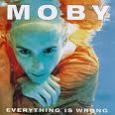
 SOUNDTRACK: MOBY-Everything is Wrong (1995).
 I suppose that everyone knows that Moby (the musician) is Herman Melville’s great- great- great- grandnephew. And that’s why he has the middle name Melville and had the nickname Moby.
Moby started out as a techno guy. He even made the Guinness Book for the fastest bpm ever recorded (since then, many have surpassed that) with the song “Thousand.” It’s an interesting song, although more for its novelty than anything else. He also had a cool hit called “Go” that sampled music from Twin Peaks. And in 1999 he took over the world with his album Play, which featured some 18 songs that were all licensed for commercial use (many of which were ubiquitous that summer).
But this disc, Everything is Wrong, came out before Play, and it was considered a high water mark for dance music (before the next high water marks of Fatboy Slim and LCD Soundsystem came out, of course).
So this disc was hailed as the big breakthrough for Moby. And it has something for everyone. It opens with a pretty piano piece ala Philip Glass which is, as its name implies, a “Hymn.” From there we get a heavy techno beat and “Feeling So Real” kicks off. Gospel-like vocals soar above the dancing (this foreshadows Play quite a bit). It sounds very 1994 to me, although I don’t think it sounds dated, necessarily. And then comes his stab at punk. “All That I Need is to be Loved” is a fast blast of aggro music. The problem is that Moby doesn’t do punk very well. His guitars are too trebly, his vocals aren’t very strong and despite the beautiful melodies he creates, he doesn’t write very catchy hooks.
“Every Time You Touch Me” returns to the style of “Feeling So Real” and is another stellar dance track. While “Bring Back My Happiness” runs even faster.
“What Love” is another screaming punk track. This one is closer to Ministry. It’s quite a slap in the face after the rest of the disc.
“First Cool Hive” slows things down with a groovy almost ambient track. And “Into the Blue” is a moody song that sounds like it could also have been taken from Twin Peaks.
“Anthem” returns to the fast beats with ecstatic moans sprinkled over the faster and faster beat.
The album ends with two tracks, “God Moving Over the Face of the World” which is a beautiful instrumental (again ala Philip Glass or more likely Michael Nyman) that weaves in and around itself for 7 minutes. (It, too, hints of Twin Peaks). And, “When It’s Cold I’d Like to Die,” while not exactly uplifting is coldly beautiful (kind of like a long lost Eurhythmics track)..
The disc is such a mishmash of styles, that it’s hard to really know what to classify it as. Some of it works wonders. Other tracks (notably the punk experiments) are less successful (even though I did enjoy them then, I think they just didn’t age well…or maybe I didn’t age well). Of course, over the course of his career, Moby has attempted all of these genres in more detail, so this was almost like a sampler of what he would be doing later.
Sixteen years later it holds up quite well (although I still think Play is better).
[READ: Week of June 7, 2010] Moby-Dick [Chapters 42-61]
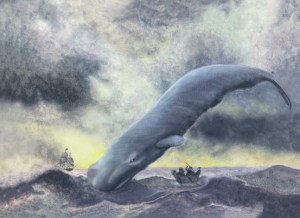
The reading this week opens with a chapter about whiteness. And how somehow Moby-Dick is even more fearsome for being white. As the chapter opens whiteness (even in skin color) is lauded. But by the end, he cites it as being particularly creepy: white whales, polar bears, albinos. (I think that this was my very least favorite chapter so far–I was uncomfortable reading it and I didn’t get a lot of humor from it either).
Some more down time passes, with Ishmael describing how Ahab is able to plot a course to find Moby-Dick. It’s not just looking for a needle in an ocean–there are pathways that whales follow, for instance. This is followed by a chapter that allows Ishmael to swear, absolutely swear! that whalers can recognize the same whale even years later if you tried to kill it but failed (and that he himself remembers one whale that got away from a mole under its eye).
Then we look again at the mind of Ahab. How even though he swore that they would seek no whale but Moby-Dick, he knows that if he wants to keep his men happy (and money is happiness) he will agree to keep hunting for other whales as well. This, in particular will keep Starbuck happy, and since Starbuck is a well liked man, who runs the possibility of mutiny, Ahab wants him placated. So, appeasement even from a crazy captain.
And then… Action!
After 46 chapters, we encounter a whale, and the chapter (which starts of with our heroes weaving a mat of some sort) suddenly bursts forth in a stream of noise and chaos while the crew chases down a whale (and despite my sadness for the whales, I was bummed that they didn’t catch this one).
But in addition to the excitement of the chase, this chapter also unveiled the ghost men that Ishmael saw climbing aboard the ship (that Elijah pointed out to him).
But at this critical instant a sudden exclamation was heard that took every eye from the whale. With a start all glared at dark Ahab, who was surrounded by five dusky phantoms that seemed fresh formed out of air (214).
And in the next chapter:
The phantoms, for so they then seemed, were flitting on the other side of the deck, and, with a noiseless celerity, were casting loose the tackles and bands of the boat which swung there…. The figure that now stood by its bows was tall and swart, with one white tooth evilly protruding from its steel-like lips. A rumpled Chinese jacket of black cotton funereally invested him, with wide black trowsers of the same dark stuff. But strangely crowning his ebonness was a glistening white plaited turban, the living hair braided and coiled round and round upon his head. Less swart in aspect, the companions of this figure were of that vivid, tiger-yellow complexion peculiar to some of the aboriginal natives of the Manillas; – a race notorious for a certain diabolism of subtilty, and by some honest white mariners supposed to be the paid spies and secret confidential agents on the water of the devil, their lord, whose counting-room they suppose to be elsewhere.
While yet the wondering ship’s company were gazing upon these strangers, Ahab cried out to the white-turbaned old man at their head, “All ready there, Fedallah?”
“Ready,” was the half-hissed reply (215).
Led by Fedallah the crew of yellow men personally sailed Ahab’s boat toward the whale. I have no idea what more will come of this but, seriously, WHAT? They’ve been at sail for how long now and these five or six men were where, exactly? No one saw them at all? I’m fascinated by this and I sure hope it gets revealed in some way.
Things settle down for a while, as we ponder Fedallah. But then we encounter our first other ship: The Goney (Albatross). When Ahab hails them, they more or less ignore him. Ishmael explains that generally whalers are pretty pleased to see other whalers out in the middle of the sea, but that Ahab is on a mission and will not repast with sailors who can’t help him with the white whale.
For indeed, there was another ship that Ahab hailed and with whom they chatted. The Town-Ho. This chapter is fascinating in that it changes the format of the book once again: This is a tale recalled by Ishmael that he told previously to a group of sailors at the Golden Inn. So it is a story of his telling a story (including those other sailor’s peoples responses). This proves to be one of the most interesting diversions so far. It does not forward the plot in any way (although it does give a passing nod to Moby-Dick). But it is a really interesting look at tempers and rank aboard a ship. It also gives an insight into how people handle confined spaces.
The next diversion looks at the difficulty of drawing/painting/creating images of whales. He provides many reasons for the difficulty: you never see whales in the sea; when whales are dead they are nowhere near as majestic even their skeleton is deceptive (they have fingers under their flippers). The most genuine picture of a whale comes from this one whaler whose leg was bitten off by a whale. He has rendered the scene on a board on which he asks for money. And boy howdy did he get it right.
We then learn about brit, which is the food that whales eat. And we also learn about the line they use to catch whales (who knew it was like regular fishing line? And then the faux excitement of a squid sighting! I was really intrigued by this chapter. But I was disappointed that the title gave away what would happen. And I was also a little surprised that the details of the squid itself were not quite as lengthy as I would have imagined (Ishmael at a loss for words?). However, given that it is a fairly unknown creatures I guess it makes sense.
This is quickly followed by the real excitement (and bloody gore) of an actual whale capture. Ishmael is (humorously) asleep on duty while a whale is pretty much resting just a few clicks away. He wakes up just in time to call everyone to arms and the chase ensues. Interestingly, the action in this section is far less crazy than the previous chase scene (where they failed to catch the whale). And, there’s no mention of Fedallah and his men. In fact this chase still talks a lot about the line!
Stubb’s men harpoon the whale and subdue it. It’s pretty gross, but more for what is left to the imagination.
COMMENTS
Thanks to Todd’s comment from last week I now have a greater appreciation of the digressions in Moby-Dick. I’m starting to think of the book as an attempt to demonstrate what it is actually like on a boat: incredible excitement interspersed with incredibly dull stretches where you have nothing to do but think (or classify whales).
I think so far the only thing that’s daunting to me about the book is when I feel I don’t have enough time to read it and I try to rush (or when I’m tired…this book can be sleep inducing if you’re half way there). There’s something about the language that really requires close reading. (Not that you should skim anything, naturally). But I find that if my mind wanders for a paragraph, it’s hard for me to pick up where we’re at, so i have to start over again.
I’m still to the point where I really wonder how this is all going to play out. There’s a number of threads that I hope he’s going to tie together for us. (But after reading DFW and Bolaño, I’ve come to expect to not have all the answers).
I have a scintillating post at the Infinite Zombies blog about Week 3, as well.

 I Just Read About That...
Hmmm, the line isn’t like fishing line as far as I’m aware. He mentions the weight each thread can hold, but then the threads are twined together to hold an even greater weight. There’s plenty of hinting that there are men on board who’re unaccounted for. Don’t forget Elijah’s deranged hints, and then Archy has an inkling. Maybe that’s not plenty, but it’s not completely out of nowhere. They’ve been hiding in the hold.
I always forget about the Town-Ho, but it’s a really interesting digression, and I think it’s the longest chapter so far. It anticipates Billy Budd, and I think part of its purpose is to bring up the notion of mutiny, which we already know is on Ahab’s mind.
For fishing line: I’ve only been fishing once or twice, so I plead utter ignorance about anything there. I did notice him saying that it was very thin. Yes, he says, “The whale line is only two thirds of an inch in thickness.” which is considerably larger than fishing line isn’t it. But he still insists that it’s smaller than you might think.
As for the other men, we the readers know they are there (Ishmael sees them boarding before Elijah asks about them), but it’s amazing that no one else (except Archy) seems to suspect anything. I really don’t have a good sense of how big this boat is, so I’m not sure how easy it would be to stowaway. I still hope we hear more about them though!