 SOUNDTRACK: New Moon Original Motion Picture Soundtrack (2010).
 Back in the 90s, it seemed like every week there was a new soundtrack featuring an unreleased song from some great alt rock band. This meant huge sales for soundtracks, even if for the most part they weren’t solid start to finish. In fact, mostly you got three great new songs, three pieces of rubbish, one great song by a band you’d never heard before and two or three okay tracks.
The inclusion of a new Death Cab for Cutie song was the big news about this soundtrack. And overall, the reviews were positive. And I’m pleased to say there aren’t really any horrible songs here. (I have no idea how the soundtrack fits in with the movie as I haven’t seen it and probably never will).
But as with that old soundtrack formula: we get a few good songs by reasonably well-known bands: Death Cab for Cutie, Thom Yorke, Bon Iver & St, Vincent, Muse, Grizzly Bear. And then there’s a whole bunch of good rock songs. The disc plays as something of a sampler of downcast, mellow alt rock. In fact, the back half of the disc sounds like a pretty decent alt rock radio station from the last decade or so.
Some of the tracks even sound like 90s alt tracks (Hurricane Bells, that song is 16 years old right? And Sea Wolf, you’re channeling Peter Murphy, I know.) The final two tracks are okay. The Editors is kind of a Nick Cave via Joy Division sorta spoken word ballad. And I admit I’m a little disappointed in the Lykke Li track–they got hyped beyond their ability. The final track is a piano score, which is fine.
The biggest surprise to me is how much that Death Cab for Cutie songs sounds like a Rush song. I’ve never considered that the bands sound anything alike before, and yet from the moment the song opens, that could be Geddy Lee singing, and that whole guitar structure is very Rush-like. Maybe they should do a cover of it.
[READ: April 20, 2010] Maps and Legends
This is a collection of 17 non-fiction pieces by Michael Chabon. The pieces cover everything from book reviews, essays about reading and writing, comic book and comic book artists and golems.
The opening essay is about the modern short story and it sets the tone for the entire book. Interestingly, this essay talks about the state of entertainment and how “Entertainment has a bad name. Serious people learn to mistrust and revile it. The word wears spandex, pasties, a leisure suit studded with blinking lights. (13). This very topic is at the heart of the David Lipsky/David Foster Wallace book (and in fact Chabon is mentioned in that book as well.) Ah, serendipity.
But the gist of the article is that the Trickster lives in between genres and entertainments and that’s where the most exciting things lie. And so, things like golems, which are not real, but sort of are, live in this transgressive world. And Chabon really seems to thrive on this realm of fiction.
The second article, “Maps and Legends” discusses the thrill he felt as a child to move into a planned community whose maps contained blank sections. As he grew up he watched them get filled it, so they were sort of there but not. A sort of nebulous existence-land. This also explains Chabon’s admiration for the His Dark Materials trilogy (“On Daemons and Dust”) even though he does seem a little disappointed by the concluding book.
But by middle reviews sections, I was getting a little bored by the book. Part of it is that several of the article originally appeared in the New York Review of Books. I’ve always sort of liked NYRoB, and yet I find that every single article in it is too long. They’re crammed with so much more than reviews, that they just come out as way too long. Another part is that there are quite a few different book reviews. And that can get exhausting, especially if (as was my case) you don’t know most of the works in question: I’ve read very little Sherlock Holmes, I didn’t know American Flagg! I don’t intend to read The Road, and I’d never heard of M.R. James. So I got a little bogged down in the middle and almost didn’t want to finish the book.
However, the back half of the collection is magnificent.
Beginning with “My Back Pages” he returns to what he does so well: telling pseudo-biographical accounts of his life as a boy and as a writer. This article looks at his absurd workspace and how well it suited him for writing his first novel. “Diving into the Wreck” goes into a great account of his failed attempt at a second novel. He had written hundreds of pages of the thing and it was grand and over the top and just didn’t work. And then, finally, without telling anyone, he aborted it and wrote Wonder Boys in just a few months.
“The Recipe for Life” is a brief look at golems (which is good lead-in to the final article).
One of my favorites was “Imaginary Homelands.” In this, Chabon theorizes about the book Say It in Yiddish, which is a guidebook for speaking Yiddish even though there really isn’t anywhere where you would speak Yiddish. And he wrote an article about the absurdly sad beauty of imagining a place where you could speak Yiddish, a place that will never exist. Well, it turns out his article outraged all kinds of people and the whole affair is recounted here in glorious detail.
The final piece “Golems I Have Known” is a transcript of a lecture he presented many times over the course a couple years. The lecture is a memoir of his life (full of truths) that is also chock full of lies. It is all about his uncle who made a golem, and the history of golems and so many other things about his family history and everything else. And it is presented so truthfully that it’s easy to get sucked up into what is patently nonsense.
The epilogue of the lecture is an addendum that talks about how fiction writers are liars, but that readers enter into a pact to accept the lies when they start reading. Except those who believe even the most absurd lie. It was funny and clever and wholly enjoyable. And I can only imagine that seeing him deliver the lecture would have been better. And yet despite all of that, people still believed that he carries the toe of a golem with him.
So, aside from the middle section (and maybe the book should have been organized differently? or maybe just broken into sections so you know what you’re in for) this was a great collection. I have only ever read his Kavalier and Clay, but reading this history of his own works makes me want to go back and read those first couple of novels to see what I’ve missed.
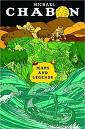
Oh, and the cover is beautiful. An artfully cut three-pieces which overlap each other with beautiful designs and colors. I was so bummed when one of the kids spilled lemonade on it.

 I Just Read About That...
[…] a long explanation of the three awesome cover sleeves of Michael Chabon’s Maps and Legends (and how each of the separate paper covers depicts things mentioned in the book (I had no […]