 SOUNDTRACK: THE DEAD MILKMEN-Soul Rotation (1992).
 And lo, the Milkmen grow up.
This disc is not funny (well maybe, a little funny); mostly it is “thoughtful” (and sometimes absurd). But what is most striking about it is how mature (mellow) it is. For this is the first album by The Dead Milkmen on Hollywood Records (a subsidiary of Disney). This combination raises far more questions than is worth looking at. But suffice it to say that even though this disc is the Milkmen, its a very different Milkmen.
The most obvious difference is that the majority (10 out of 13) of the songs are sung by the artist formerly known as Joe Jack Talcum, now known as Butterfly Fairweather (perhaps Hollywood knew that “”Punk Rock Girl” was their big hit?). Past DM records were mostly sung by Rodney Anonymous (who goes by H.P. Lovecraft on this disc). And his were the heavier, weirder, funnier, absurdist tracks, for the most part. So, when the first four songs here are sung by Butterfly, you know something different is afoot. Oh, there’s horns on the disc as well!
The disc feels like a pretty typical alt-rock band from the 90s. But it’s missing the sass, it’s missing the vulgarity. Basically, it’s kind of dull.
That’s not to say there aren’t good songs on here, because there are. “If I Had a Gun” is a great screamy Butterfly song, and “Wonderfully Colored Plastic War Toys” is full of Lovecraft’s snark. As is “The Conspiracy Song” a lengthy rant of absurdity.
The rest of the songs drift between mellow and alt-rock rockers. And it works as a product of the alt rock 90s. It’s just not much of a DM album.
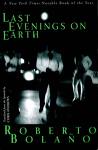
[READ: April 8, 2010] Last Evenings on Earth
I have been reading Bolaño’s short stories for a while now. And so I have read a couple of the stories in this collection already. The stories in this collection were taken from his two Spanish collections of short stories: Llamadas telefônicas (1997) and Putas aseinas (2001). And I have looked at about a dozen sources but I can’t find which stories came from which original collection (I like to know these hings). I can’t even find a table of contents for the original books. Anyone want to help out?
I enjoyed these stories more than I expected to. I have read some of his stories in The New Yorker and elsewhere, and I’ve been okay with them, but this collection blew me away. Whether it’s being immersed in his writings or just having them all in one place, I was thrilled by this book.
There so many delightful little things that he does in his stories that I find charming or funny or something. Like that his narrators are usually two or three people removed from the details. Or if they’re not, they act like its been so long they doesn’t need to get all the details right: “U insults and challenges him, hits the table (or maybe the wall) with his fist” (“Days of 1978”).
I also get a kick out of all the stories with the protagonist named B. Which seems a not so subtle way of saying he’s the narrator (even though I ‘m sure these things never happened to him quite like it says (despite all the biographical consistencies with his own life).
The opening story “Sensini” has the narrator working as a night watchman at a campground (much like Enric in The Skating Rink…a bit of biography perhaps?). A number of his stories are simply biographies of interesting characters (something he went to extremes with in Nazi Litearture in the Americas): “Henri Simon LePrince” a failed writer in Post-WWII France. “Enrique Martin” a delightfully twisted story about jealousy (aren’t they all, though?) and acting impulsively and foolishly (aren’t they all though?). This one featured a riddle that I’m not even sure we’re meant to get:
3860+429777-469993?+51179-588904+966-39146+498207853
which the narrator thinks is a word puzzle.
“Anne Moore’s Life” is a fully realized biography of a woman who makes one bad decision after another. While “Mauricio “The Eye” Silva” is about a man swept up in a situation who acts impetuously and then regrets it.
I read Gomez Palacio here. And I think I may have read “Last Evenings on Earth” already. It says it was written in the New Yorker, but I can’t find it anywhere. Nevertheless, it seemed very familiar: the bar, the threats, the blow job. And yet there were many parts that I didn’t remember: the boat, the swimming, the poetry. And it ends wonderfully.
“A Literary Adventure” is a great story of paranoia as B, a writer, mocks A in a novel which A then praises (presumably not recognizing himself in it). Then B feels guilty and well, the whole thing spirals out of control.
“Phone Calls” features B again, this time making calls to X, an actual ex-. When X is killed he’s suddenly a suspect. “The Grub” was a very visceral story (and one of my favorites) about a man who looks (not literally) like a grub, and the narrator becomes connected with him in many ways.
“Days of 1978,” set in Europe amidst a group of exiled Chileans, is self-deprecating and funny, especially with the line: “This is where the story should end, but life is not as kind as literature.”
“Vagabond in France and Belgium is a story of a wanderer, B, who travels to France and Belgium but never really finds anything. It name checks a number of people especially Henri Lefebvre.
“Dentist” seems to play with an idea that is buried in the story itself. In the story, a young farm worker turns out to be a writer and one of his stories has wholly divergent ideas written in one story. And that’s true of this too: it begins with a dentist fearing he has killed someone, switches to a story about perceived homosexuality and then winds up in the farm boy’s house amidst his novels. It may have been that I was staying up too late to finish this story but I wasn’t as gripped by it as I was with most of the others.
The collection ends with “Dance Card.” This fascinating little story is similar to Antwerp (coming soon) in that it is series of numbered ideas. (Not sentences), totaling 69. It seems to be a series of autobiographical concepts, although again, I don’t know if they are accurate. It was the least engaging of the stories, but probably should have gone first as it seems to provide context for everything else.
I enjoyed this book very much. As with most of the other Bolaño I’ve read, it featured prostitutes, violence, neurotics and poets. The stories didn’t all end satisfyingly, but they were all very satisfying to read. I feel very lucky to have discovered this master of the short story
For ease of searching I include: Bolano
I am also including the original line up (thanks Eric) of the stories in their original publications, just for anal retentivity). Titles in blue appear in The Return.
PUTAS ASESINAS’ contents (translations are approximate now official):
El Ojo Silva (Mauricio “The Eye” Silva)
Gómez Palacio (Gómez Palacio)
Últimos atardeceres en la tierra (Last Evenings on Earth)
Dias de 1978 (Days of 1978)
Vagabundo en Francia y Bélgica (Vagabond in France and Belgium)
Prefiguración de Lalo Cura (Prefiguration of Lalo Cura)
Putas asesinas (Murdering Whores)
El retorno (The Return)
Buba (Buba)
Dentista (Dentist)
Fotos (Photos)
Carnet de baile (Dance Card)
Encuentro con Enrique Lihn (Meeting with Enrique Lihn)
LLAMADAS TELEFÓNICAS is evidently broken down into three sections
(this is all from Wikipedia, so I’m taking their word for it).
*LLAMADAS TELEFÓNICAS:
Sensini (Sensini)
Henri Simon Leprince (Henri Simon Leprince)
Enrique Martín (Enrique Martín)
Una aventura literaria (A Literary Adventure)
Llamadas telefónicas (Phone Calls)
* DETECTIVES:
El gusano (The Grub)
La nieve (Snow)
Otro cuento ruso (Another Russian Tale)
William Burns (William Burns)
Detectives (Detectives)
* VIDA DE ANNE MOORE
Compañeros de celda (Cell Mates)
Clara (Clara)
Joanna Silvestri (Joanna Silvestri)
Vida de Anne Moore (Anne Moore’s Life)

 I Just Read About That...
Putas Asesinas’ contents (translations are approximate):
El Ojo Silva (Silva’s Eye)
Gómez Palacio
Últimos atardeceres en la tierra (Last sunsets on earth)
Dias de 1978 (Days from 1978)
Vagabundo en Francia y Bélgica (Vagabond in France and Belgium)
Prefiguración de Lalo Cura (Prefigurations of Lalo Cura)
Putas asesinas (Killer Whores (?))
El retorno (The return)
Buba
Dentista (Dentist)
Fotos (Photos)
Carnet de baile (Dancing Credential)
Encuentro con Enrique Lihn (Encounter with Enrique Lihn)
I have not read Llamadas telefonicas, but wikipedia has some info on it: http://es.wikipedia.org/wiki/Llamadas_telefonicas
Cheers
Thanks Eric,
I knew I could count on someone to have a copy handy! Now I get to see what kind of thread ran though the books!