 SOUNDTRACK: FLAMING LIPS-She Don’t Use Jelly (1993).
 This single contains three B-Sides: “Translucent Egg” is something of an instrumental version of “She Don’t Use Jelly.” It uses the same opening guitar riff, but it changes a few things along the way. The highlights though are the other two tracks: variants from Transmissions from the Satellite Heart. “Turn It On [Bluegrass Version]” is, as advertised, a stompin’ bluegrass version of that track (with help from the Butthole Surfers), and “******* [Porch Version]” is a solo acoustic version of “Plastic Jesus.” Probably not an essential disc, but the alternate versions do highlight the quality of the songs and not just the raucous effects on the main disc.
[READ: Fall 2008 & March 24, 2009] The Spiderwick Chronicles
I started this series in the Fall of 2008, and for some reason, didn’t finish volumes 4 and 5. I saw them on my night stand and decided it was time to polish them off. And so I did.
I had originally intended to write about each volume, but that is not feasible now. So, instead I’ll give a summary of events and some overall commentary.
First: Sarah and I get annoyed by books that are set up as an obvious sequel generator. Or, in this case, a book that is set up as a series. Now, series’ are all well and good, and some of the best books are series, but in the case of Spiderwick, the series seems to be just a way to make money. For this series you get 5 books, all retailing for $11. Each book is around 128 pages. The books are also tiny sized (dimensions of a paperback). All I’m saying is you could easily make this book a regular sized hardcover that would come in at around 350 or so pages and charge $17 for it.
But having said that, maybe this is the way to go for kids books. It’s small, and easy to carry, it allows kids to get into a series and leaves them hungry for more. And, really there is somehow more appeal to the series in this format. So, marketers may know what they’re doing after all.
But enough complaining.
This series is really enjoyable. The art by Tony DiTerlizzi is amazing. He has a great knack for thin-lined, expressive drawings, and his credentials land him squarely in the realm of fantasy. His art appears every few pages, and it really adds a lot to the book. Occasionally, the captions for the art give away what is just about to happen but really you’re moving pretty quickly so it doesn’t ruin anything.
And the story?
Holly Black has created a delightful, if bizarre world in which elves, goblins and other creatures live not too far from humanity. It’s never addressed how Mulgarath, the goblin leader lives in an enormous junkyard castle and no one has noticed it before (true, the kids are granted The Sight by goblins, but it is a giant junkyard after all, plus, their mom doesn’t have The Sight in the end). But that’s okay, by the time Mulgarath arrives you’re pretty well wrapped up in the plot.
And th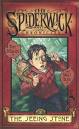 e plot? The story concerns the Grace family. The family is divorced, and the three kids Mallory (13), and the twins Simon and Jared (9), live with their mom. After Jared gets in trouble at his old school, they move to Spiderwick Estates (an old family property) in New England. The house is run down, and sections are uninhabitable. The property was most recently owned by their Aunt Lucinda who is in an asylum because she talks to fairies.
As for the kids, to paraphrase a section of Book V in which Jared wishes his dad knew more about them: Jared is a troublemaker, Simon loves animals and Mallory is a fencer. Obviously, there’s more to them than that, but these characteristics are strong throughout the series.
The five books are:
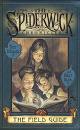
The Field Guide (May 2003)
The Seeing Stone (May 2003)
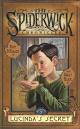
Lucinda’s Secret (October 2003)
The Ironwood Tree (April 2004
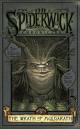
The Wrath of Mulgarath (September 2004)
Without trying to break the plot down by book, I’ll explain that as the story opens, this kids find a secret room that belonged to their great- great- uncle, Arthur Spiderwick. He has crafted a book that talks all about the magical creatures around them, including goblins, hobgoblins, dragons and ogres. While wandering around this attic room, they encounter one of these magical creatures, Thimbletack. Thimbletack is a brownie who can be good, but if annoyed can (and does) cause great mischief to them.
 Various troubles ensue as the books progress. they encounter goblins (who are evil) and hobgoblins (who are not evil but are very selfish) and a griffin [a flying lion/eagle creature] (which Simon brings home to help him heal, and names him Byron). They also encounter magical elves and learn a little bit more about Arthur’s mysterious disappearance. Later, they visit their Aunt Lucinda and discover that the real reason she is in the asylum has more to do with Arthur’s discoveries (which no one else
  believes) than anything else. Lucinda is able to point them in a useful direction.
As the tale progresses (and it’s hard to tell exactly home long the story lasts in Spiderwick time, no more than a few days, I would guess), the kids get into more trouble: Jared at school and Mallory with some dwarves who capture her. It is in the 4th book that we finally encounter Mulgarath, the ogre. Mulgarath has the ability to shape shift, and he is very convincing at it.
 As the last book opens, the kids realize that their entire house has been overrun by goblins, and that no one is safe, including their mom. The kids return to the junk yard to confront Mulgarath. It is here that to me the book moved a little too quickly. Rather than an epic confrontation, the fight with Mulgarath is actually kind of tiny with a (SPOILER ALERT) rather funny but somewhat unsatisfying end to Mulgarath.
The denouement is quite satisfying however, with the reunion of many characters. Despite a sad moment, it is very touching all around.
And that’s that.
The series is pretty fast moving. I read book five in a couple of hours. The pacing is quite good too. Unlike some books where the characters fail and fail again, the kids don’t seem to fail so much as they just find newer obstacles to overcome. The challenges the kids face aren’t a clever as some of the other recent books of this ilk that I’ve read (Mysterious Benedict Society for one), but that’s clearly not the point.
A quibble is that some of the events seem really obvious and it’s surprising to me that these smart kids don’t catch on right away: like the true identity of the salamanders and the man chained up with their mom, but I guess that’s how you create more dramatic scenes.
The one thing that really bugged me from the beginning and even months later when I started up again was when the action was phrased that Simon or Jared sat down next to “his twin.” Throughout the book he grabs “his twin’s” hand or does something or other with “his twin.” Now, I’m not a twin, so I don’t know if this is just how twins think of each other, but I suspect it isn’t. It felt like a really awkward way of not saying the boys names a lot. I don’t know why that bugged me as much as it did, but so be it. It doesn’t really detract from the story, it’s just a stylistic thing. But man it happened way to often. I mean, we know they are twins! We aren’t forgetting that.
Anyhow, this is a cool and interesting series that I enjoyed. It seems a little dark at times, but I suspect that nine-year-olds could handle it. If you enjoyed Harry Potter, you know what to expect, and this will be like a light snack compared to the Potter series.

 I Just Read About That...
Leave a comment