 SOUNDTRACK: BLACK MOUNTAIN–In the Future (2008).
 An ironically titled disc, surely. Black Mountain is a Vancouver-based band that specializes in 70’s era psychedelia with a heavy dose of Black Sabbath. Yet, like Dungen or other bands that tread this “revivalist” style, they don’t mimic the sound..they definitely sound contemporary, but the vibes of the 70s are constant.
Black Mountain features two singers: Stephen McBean and Amanda Webber. Webber’s voice in particular harkens back to an amalgamation of Grace Slick of Jefferson Airplane, Nancy Wilson and the collective voice of Fleetwood Mac. McBean sounds like several singers of the era too.
“Stormy High” opens the album with the best Black Sabbath riff that Sabbath never wrote. It sounds like something straight out of Sabotage. “Angels” slows things down into a kind of Bad Company vibe, complete with trippy 70s keyboards in the middle of the song. “Wucan” sounds more contemporary (the vocals in particular remind me of something, but I can’t place it) and “Stay Free” is a nice acoustic ballad. “Queens Will Play” gives Webber the spotlight and the song in particular sounds like a wonderfully creepy take on Fleetwood Mac.
Although some of the songs are longish (6-8 minute), most of them are fairly brief. Except, of course, for the 16 minute “Bright Lights”. I think it’s fair to say that 8 minutes could be cut off of this song and it would still be great. The middle riff-tastic part is really fantastic, but the opening and the noodley keyboard solo could easily be lopped off.
The disc also came with a bonus disc of 3 songs. Each one adds to the mythos of this fascinating band. I’m curious about their debut release as well.
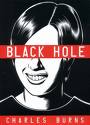
[READ: November 8, 2008] Black Hole
My friend Andrew loaned me this book. I had recently read an interview with Charles Burns in The Believer (and more abou that in a moment), which excerpted this book. It looked really good, but then I promptly forgot about it. And Andrew filled in the gap for me.
Charles Burns’ work appears in astonishingly diverse places. I know him mostly because he is the cover 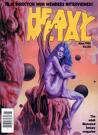 artist for The Believer, (his interview in that magazine is pretty great) and his been since its inception. But I also know him from the early 80s when he was an artist with Heavy Metal magazine–when I did a search for this magazine, this was one of the results, and I distinctly remember it being in my magazine collection (gosh, some 25 years ago?).
His main character then was a masked wrestler 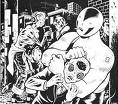 called El Borbah.
 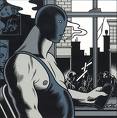 He kind of freaked me out back then, but my mind hadn’t yet been warped by cartoons and college.
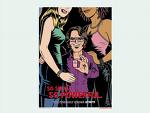 But clearly I’m not the only one sucked in by his style these days, as he is now doing advertisements for Altoids.
To me there is something so compelling about Burns’ style. He uses black so effectively. Many of his scenes are set in an all black background with little lines of white that illustrate perfectly what is happening. But when the background is white, 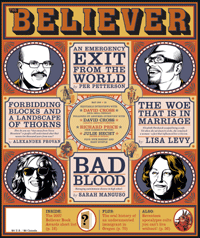 he uses thick black lines that are amazingly emotive. You can even see by the covers of The Believer how his works aren’t caricature in any way, yet he manages to accurately render the subjects he’s portraying. A recent example has two pictures of David Cross corresponding to the two interviews in the book (good David and evil David).
But enough background.
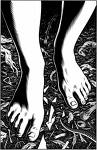
This story is a graphic novel (duh). It is set in Seattle in the 1970s. The basic plot is that teenagers (there are no adults in the story…all are literally away on vacation or unseen in other rooms) are contracting a virus through sexual intercourse. This virus turns them into mutants. The mutations are always different, and often quite freaky. (The underlying metaphor for AIDS was not lost on me).
The story follows the lives of two uninfected teens as they–unintentionally in one case and seemingly on purpose in another–contract the disease and deal with the consequences. Keith is a shy kid who secretly longs for Chris, a beautiful girl in his biology lab. She seems unapproachable, but on one occasion he did manage to talk to her. Keith spends most of his time hanging out with his friends, getting stoned.
Chris, meanwhile, is not interested in Keith. Rather, she has designs for Rob. One drunken evening, she finally gets the courage to talk to, and eventually make out with him. When things are getting heavy, he tries to tell her that he has the disease but she hushes him because she thinks that he’s going to say something else. Rob’s disease is the first one that we see up close: a mouth on his neck (and it tends to babble while he sleeps…ew). Chris is devastated to learn that she has the disease, but ultimately decides that she loves Rob and will stay with him (especially since he didn’t mean for her to get it).
They move to a tent in the woods where most of the mutants live. In these scenes you get to see what some of the mutations really look like.
Keith learns that Chris has become infected (her skin peels of with relative ease). He is still interested in her, but rapidly realizes that she is really hung on up Rob. He meets more of the mutants and seems comfortable with their outsider status. He then runs into a woman, Eliza, who lives with their pot connection. Eliza  has a tail, but Keith is utterly seduced by her liberated attitude.
The protagonists’ lives intersect a few times, but really, we see them delving deeper into their own troubles. The story can’t possibly end well for anyone, but the difficulties they encounter make for very compelling reading. I stayed up way too late finishing the story.
While the story is intriguing and compelling, it’s really the artwork that gets you sucked in. As I said, Burns’ style is fantastic. And his attention to detail is amazing. In these black scenes, you can make out all of the details on a littered ground, or of the stars, or the pain on someone’s face. The mutations are grotesque and horrifying and yet after several pages, you become used to them–you may even find some of the beautiful.
It’s a really great story. But not for the squeamish!

 I Just Read About That...
[…] BURNS-”Black Hole” & “1963 Cat Club” I loved Black Hole, this is an excerpt. The “1963 Cat Club” is a drawing he did when he was 7 and it […]