 SOUNDTRACK: COHEED & CAMBRIA-In Keeping Secrets of Silent Earth: 3 (2003).
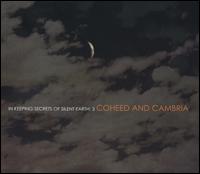 I had recently reviewed Co&Ca’s Good Apollo… CD which is the part that comes right after this one. I have yet to hear the one that comes before this one (I’m being vague about the numbering since the first album is called …2, the second one is this one (3), the third one is IV, Vol. 1 and the fourth is IV, Vol. 2. I understand that Part 1 will come out later as the fifth album, so…try to keep it all straight, okay!
Anyhow, as I said, my only exposure to Co&Ca was Vol. IV, Part 1, an album I enjoyed very much, with its combination of metal, prog rock, guitar wailing, and catchy emo-like lyrics. This record was slightly less enjoyable for me. I almost feel like they really perfected their sound with IV, and on this one they were still playing around with a suitable style.
There’s something a little tentative about this album overall, and perhaps its not fair to have listened to IV before 3, but that’s what I did. There are a couple of slower ballads on this one which suit Claudio Sanchez’ voice really well. But overall, this one seems to be a bit heavier, but also less catchy and less prog rockish….and yet there are elements of both here. It just feels like they weren’t quite ready to blow our minds yet.
I still have yet to figure out what the story is about. This is mostly my fault as I haven’t had a chance to really peruse the lyrics (and his voice is high enough that it’s not always apparent what he’s saying). But I gather that it is still a pretty violent story (there’s even a disclaimer at the end of one song to not take it literally, as it’s only a story).
Despite my less than stellar rating, I’m still intrigued enough to get the whole series. I can’t decide whether to go back to 2 or forward to IV Part 2 next….
[READ: August 5, 2008] Petropolis
I picked up this book based solely upon the cover and title. I saw the graphic way that Petropolis was written, and I assumed that it has something to do with gas, (petrol-opolis). Which sounded funny. Well, my instincts were utterly wrong. It had nothing to do with that, and while it was a little funny, it was not anything like what I was expecting (some sort of dystopia ala Gary Shteyngart’s Absurdistan.)
This is the story of Sasha Goldberg, a young girl growing up in the unbelievably named town of Asbestos 2 in Siberia, Russia. Aside from being poor and living in Siberia, Sasha has two other strikes against her: she is Jewish and she is one quarter black. Her father, Victor, was born of a Russian woman and an African vacationer. He was put up for adoption, and was, surprisingly, adopted by a wealthy Moscow family. When his parents are both killed in a car crash, Victor’s life changes dramatically. He is sent to an orphanage, until he joins the military. Now THAT’s backstory!
Victor meets and marries Lubov, a “librarian” living in Asbestos 2. They meet at the hospital where she is visiting (ie. bringing special books from the library to procure favors for patients). When Sasha is born, she looks little like her mother–a blonde beauty–and enough like her father to really stand out in pale Siberia. She is picked on by her peers and even by her mother who feels she does not put enough effort into… well… anything. Soon her father leaves her and her mother for America. Her mother then removes all trace of him from their house, as if he never existed at all. It is only when Sasha discovers art school that she feels that there is something worth doing with her life. Oh, and Sasha has gotten pregnant and given birth to her daughter, Nadia. Sasha’s mother insists on raising Nadia as her own daughter, despite what Sasha says, in an attempt to let Sasha grow. And all of this happens before Sasha turns 14.
Through some interesting decisions, she makes it to America. She considers looking for her dad, but has no idea even where to start. However, she makes good use of the Russian immigrant network and winds up as a house cleaner for a very wealthy Chicago family. Their youngest son, Jake, has cerebral palsy and is wheelchair bound. Despite how freaked out she is to see him at first, she soon realizes that here is one individual in no position to make fun of her (despite his gruff demeanor). They each let their guards down for each other, and he assists in finding her father, who is living in New York. And at this point we’re only 2/3 of the way through the book.
The final third of the book shows Sasha trying to come to terms with her alien father and his new family. She also sets out to make her mother’s life better in Asbestos 2. However, in the years that she has been away, Asbestos 2 has basically been abandoned, except for the final remaining families, which include Sasha’s mother and daughter. She will do anything to help them flee to America, even though Lubya doesn’t want to go and Nadia is afraid of her (and frankly, Sasha’s not so sure she can take care of a child after all).
Despite all of the harrowing events that happen to Sasha, she keeps a cynically positive outlook. She may not think that something good will come along, but she will persist regardless of what happens, just to spite everyone else. And, despite her hardened exterior, the book stays warm and inviting.
I was surprised how much I enjoyed the book; however, it’s hard to know who to recommend it to. A taste for post-Soviet Russia might be helpful, but really, it’s about a young girl who overcomes just about everything that is thrown at her. This very well could be a YA novel, and I’m not sure exactly why it’s not, except that several of the chapters break from following Sasha and get into the POV of Lubov, Victor, Jake and even Victor’s new wife.
Interestingly enough, this book also contained drawings by the narrator, like Special Topics in Calamity Physics. Unlike that one, these pictures are used only as the section front pages; however, one imagines that they were drawn by Sasha.
This is Ulinich’s first novel. Like Sasha, she is a native Russian, and yet she wrote this novel in English. You’d never know it wasn’t her native language. And it makes me even more disappointed in myself that I don’t write more fiction.
There’s an interview with Anya Ulinich on NPR here. And, the book’s own website is here, where you’ll see more drawings and other cool things.

 I Just Read About That...
Leave a comment