 SOUNDTRACK: NIRVANA-Sliver: The Best of the Box (2005).
 So, my $1.50 copy of this came in today and I listened to the three unavailable tracks. The first was a track called “Spank Thru,” which was totally new to me. The other two were demos of: “Sappy” (also known as “Verse Chorus Verse” on the NoAlternative compilation) and “Come as You Are” from Nevermind.
“Sappy” is one of my favorite Nirvana songs. I tend to forget about it because it’s on the compilation and not one of their records. This version is a little slower, and was one of the original studio recordings of it.
“Come As You Are” is a great song from Nevermind. This is a boom box demo. Not the most insightful recording, but interesting for completists.
“Spank Thru” is a very early recording from when Nirvana was called Fecal Matter. It’s one of the few recordings (aside from Cobain’s solo recordings) that doesn’t have Krist Novoselic on bass (Dale Crover plays bass). I’m not sure why they didn’t release any other tracks from the demo, as it is by far the most “interesting” thing of note on the collection. It’s interesting to see a young Kurt writing a song like this which starts out mellow, but in a very different style than the Nirvana mellow ™. Hearing it many years after the fact, it almost sounds like a joke with Kurt “crooning” the opening verses. I gather there’s a live version on From the Muddy Banks… I guess I don’t listen to that record very much.
It was certainly worth paying $1.50 to hear this song. As for the rest, I guess if you’d like to hear Nirvana demos, but not a box set worth, then this is the way to go. There are some highlights from all the phases of Nirvana’s career, with none of those excessive jams that make the box set a little tedious.
One final Nirvana thought: this collection made me realize just how long most Nirvana songs are. Even though Nevermind sold billions of copies, it wasn’t really radio friendly. Even the hits approach the five minute mark. Hmm, maybe the world was once ready for non-commercial radio. American Idol has certainly nailed the coffin lid shut once again though.
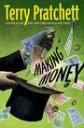
[READ: October 20, 2007] Making Money.
I finished the last chapter of this book about ten hours after my daughter was born. I was still pretty wired from the whole experience, and only had about 30 pages to go, so I stayed up while everyone else was asleep and finished just as I was starting to crash.
Anyhow, prior to reading this, I had been reading a variety of books, both fiction and non-fiction. As I opened up the first page I remember thinking that starting a Terry Pratchett book was like talking to an old friend. It all felt so comfortable, so familiar, so right. I don’t get quite the same feeling from the Tiffany Aching series, probably because I haven’t read thirty or so books in the series already, but once an adult Discworld novel pops open, all the familiar sights and smells of Ankh-Morpork come flooding back.
Over the years, Pratchett has introduced lots of aspects to Discworld. He has parodied pop culture (The Fifth Elephant) but he has also made statements, or perhaps observations, about the world we live in (The Truth). And the last few books have moved away from some of the broader topics into some really interesting observations about human nature (which he has been doing all along, of course…maybe it’s when he focuses primarily on one character as opposed to a group (the witches or the city watch) that the book can feel more personal…?) Anyhow, I’ll send you to this Wikipedia entry if you want to see exactly what kind of themes each book in the series covers. This is a really handy chart for keeping track of the massive world of Disc.
Making Money is the follow up to Going Postal. In that one, the main character, Moist von Lipwig, a former criminal who was condemned to be hanged, was given a reprieve by Lord Vetinari and was put in charge of the Ankh-Morpork Post Office. His success at this venture (including the minting of stamps and his fabulous arrival in a gold suit) prompted Vetinari to put him in charge of the Ankh-Morpork bank. (A fascinating situation for a former con man to be in).
The bank is initially run by an old woman, whose family is a bunch of greedy unpleasant types. They simply can’t wait for her to die and get their hands on the money, em, bank. As it turns out, when she does die (early in the book), she wills the bank to her dog, and makes Moist the dog’s new owner. Thereby making him the owner of the bank.
And so, essentially the book is about banking, what some consider to the be the most boring subject on earth. And yet, in Pratchett’s hands, it is not only compelling, it is hilarious. What follows is a look into the origins of paper currency, the gold standard, greed, loans, trust, and golems–lots and lots of golems. You see, Moist’s girlfriend is in charge of an organization, the Golem Trust, created to protect the rights of golems. And, golems can be a very powerful entity, whether they are free or not. Just see what Gladys can do to a sandwich.
As in most of the Discworld books, there is just so much that simply makes you laugh because of how true one of his wry observations can be. And yet he never risks the story just to make a joke. Pratchett is probably one of the most prolific writers I can think of (excluding your Pattersons and your Steels who simply MUST have ghostwriters helping them). I believe it was Neil Gaiman who said of Pratchett: (And I’m paraphrasing here) “He set out to write 30 pages a day. When he got to the end of the book, he had only typed ten pages that day. So, he put in a new sheet of paper and started a new book.” I love that story. And rather than getting worn down by the amount of output he produces, Pratchett genuinely seems reinvigorated by whatever topic he’s skewering.
I really can’t say enough about the Discworld series. He has pushed it so far beyond a fictional location. It is a three dimensional universe that in every detail, almost exactly matches a fictionalized version of our own. And it is very funny. I Can’t wait for the next one.
The delightful thing about the Discworld Series is that you don’t HAVE to read it from the beginning. And, if you are intrigued by this book, I wouldn’t want you to have to read 35 other books before you get to this one. In fact, you don’t even really have to read Going Postal first. The books are nicely self contained, but the more you read, the more inside jokes you will get.
And what of Moist? Well, without giving away too much, let’s say there are threats on his life from both in and outside of the bank. There are disgruntled workers. There is a whole matter of missing gold. And, then there are those pesky golems. Oh, and Moist’s inspiration for creating paper currency is such a great bit, that it’s worth reading the rest of the book just to get to it.

 I Just Read About That...
Leave a comment