 SOUNDTRACK: BJORK-Volta (2007).
 Okay, so Bjork is from Mars. Volta is her newest album. I’ve been a fan of Bjork since the Sugarcubes, way back when. I’ve also really enjoyed her solo recordings. I used to get all of her singles and videos and things, but in recent years she seems to have released a new full length reissue of a concert or remastered disc on a monthly basis. So, I had to go cold turkey.
Then Volta came out. I saw a live performance of two of the songs on Saturday Night Live, and they were pretty different, even for her. It seems like Bjork has had a unifying sound on each of the last few albums. On Volta, it is a horn section. This is a more organic sound than some of her recent electronic releases. And, overall, I find that it doesn’t work all that well for her.
Bjork’s voice is, and I mean no disrespect because I love her voice, but it has many similar qualities to a horn. It is loud, she can hold notes for a long time, and it can often be quite brash. And, she is an alto, which many of the horns are too. So, I find that her voice blends in too much with the music. Whereas on previous records, her voice really stood out. There’s a similar problem in the duet with the ubiquitous Antony (of Antony and the Johnsons). Their voices are so similar, that any sense of conflict or drama is really lost. (I’m not mocking Antony’s voice. It is quite sublime on his own records, but I feel that it doesn’t do much for “Dull Flame of Desire,” even though the song itself is great.)
However, the entire album does not have horns, and I’d say at least half of the album is great, Bjorkian music. The first four songs are really great, weird beats and noise and fun. The middle tends to drift aimlessly, though. There are several ballads that blend into each other. Two of them include a fascinating instrument, the pipa. In fact, the instrument is so fascinating that it completely overshadows Bjork (if you can believe that) and I wind up spending the time trying to imagine how this instrument is played. The album ends with “Declare Independence” a brash, noisy punk anthem that wakes you out of the serenity of the middle of the record. I’ll probably be skipping some of those slower songs on future listens but the beginning and end are great. Although what is with all of those foghorn sounds?
In fact, this weekend I listened only to track 5-8 three times in a row and I just got nothing out of them. Sorry, Bjork, but I didn’t feel it. Still enjoying 1-4 & 9-10 though!
[DIGRESSION]: My Bjork encounter:
Several years ago my wife and I were flying back from a trip to Denver. We knew that Bjork has just played at Red Rocks, so when we were on the Continental flight and saw a woman who looked oh so much like Bjork, we joked that it might be her. Well, during the flight, about fifteen people who looked a lot like Bjork flooded the aisles around us. And so we decided it must be Bjork and co. flying in coach! When we landed, we got into the pre-luggage area, and “Bjork” was standing there, so I approached cautiously (knowing she’s had stalker problems), asked if she was Bjork, she shook her head vigorously “No.” I told her that if she was Bjork, that I loved her music since The Sugarcubes and walked away. Then later on, by the luggage rack there were all kinds of black cases with Iceland written on them. So, I refuse to accept that this was not Bjork, especially since she ran up the deboarding ramp with her young child in a serpentine pattern. So, I think it’s fair to say I met Bjork. And I’m sticking to it!
[READ: September 13, 2007] “Fiction.”
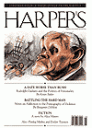
I am fond of Alice Munro, but I can’t say that I’ve read very much by her. I have secured a copy of Runaway, but haven’t read it yet. This story came in Harper‘s and it was really really good.
The story is set up in three parts, as a sort of before, middle and after. It focuses on a married couple living in the woods of Vancouver. Their marriage suffers a crisis when her husband reveals that he has fallen for his apprentice (a self-righteous, heavily tattooed single mom). The second section concerns Joyce (the protagonist of the first section) and her new life after the break up of her marriage. Part three is the best part of all, in which we learn that the daughter of the apprentice has written a collection of short stories. [Munro has a great line about short story collections not being “real” books, which is funny since she writes mostly short story collections]. It turns out that one of the stories concerns her, in her role as the young girl’s music teacher.
It is a sad story, as I think most of Munro’s are. But it’s a very satisfying one. She writes in a very elegant style about relationships and small town Canadian life. And, her characters really come to life. I imagine it would be hard to read a lot of her stories in one sitting, but like a fine wine, an occasional glass is quite rewarding.

 I Just Read About That...
Leave a comment