Feeds:
Posts
Comments

Archive for the ‘Owls’ Category

SOUNDTRACK: LEY LINE-“Oxum” (SXSW Online 2021).

I never intend to go to SXSW–I find the whole thing a bit much.  But I also appreciate it for the way it gives unknown bands a place to showcase themselves. NPR featured a half dozen artists online this year with this note:

This year, the South by Southwest music festival that takes over Austin, Texas every spring happened online. Couch By Couchwest, as I like to call it, was an on-screen festival, with 289 acts performing roughly 15-minute pre-recorded sets across five days in March.

This list was curated by Bob Boilen.  He also notes:

 I didn’t enjoy hearing loud, brash music while sitting on a couch the way I would in a club filled with people and volume, so I found myself engaging in more reflective music instead.

I’m going in reverse order, which means Ley Line is next.

Ley Line is four women, based in Austin TX, playing an upright bass, a guitar and soft percussion.

The first ninety seconds of this song slowly evolve from a pretty guitar melody and lead vocals, to harmony vocals supporting a lead vocal and a soft echoing drum

And then the bouncing drum is joined by cymbals and a satisfyingly deep bass melody.

Ley Line is four singers, including a pair of twin sisters, who find inspiration in music from Latin America, West Africa, and Europe as well as North America. The simplicity is what I loved most about this Austin-based group, both in its spare percussion and lovely harmony.

It’s fascinating to hear to song shift from Spanish to a wordless language (I think) to English, all while retaining a similar sound.

That is until three and a half minutes when the song suddenly shifts to a a dancey song.  Bouncy bass, a fast rhythm and more of that cheerfully singing (in Spanish once again).  It’s quite arresting.

[READ: July 10, 2021] “Understanding Owls”

David asks the universal question, “when does one reach a point in your life when you say ‘I’ve got to weed out some of these owls?'”  We’ve all been there.

Of course, you don’t want to hurt anyone’s feelings, so you can’t get rid of the crocheted owl from your sister.  You keep the owl napkins and candles–those are useful. But trivets and trinkets can go in the trash or to goodwill.

This overwhelming feeling happens when you tell people you like something.  His sister Amy said she liked rabbits and soon enough, she had cushions, slippers, bowls, magnets etc.

Amy’s started with a live rabbit.  But Hugh and David’s owls started with art.  Hugh painted birds on a client’s ceiling.  He painted song birds and then she asked for owls.

It made no sense nature-wise–owls and songbirds work different shifts, and even if they didn’t they would still never be friends.

But it was her ceiling so he did it.

He bought the book Understanding Owls to learn what they looked like.  The book became an inside joke for them–i wish I could see what a barn owl looked like, if only there was some guide nearby to show me.

Then, pushing the joke further, David decided to buy Hugh a stuffed owl.  But he learned that it is illegal to own one in the United States–even if it dies on your property you cant keep it.

he had gone to a taxidermist.  One taxidermist even went so far as to stretch a chicken over an owl form.  It was disturbing. (more…)

Read Full Post »

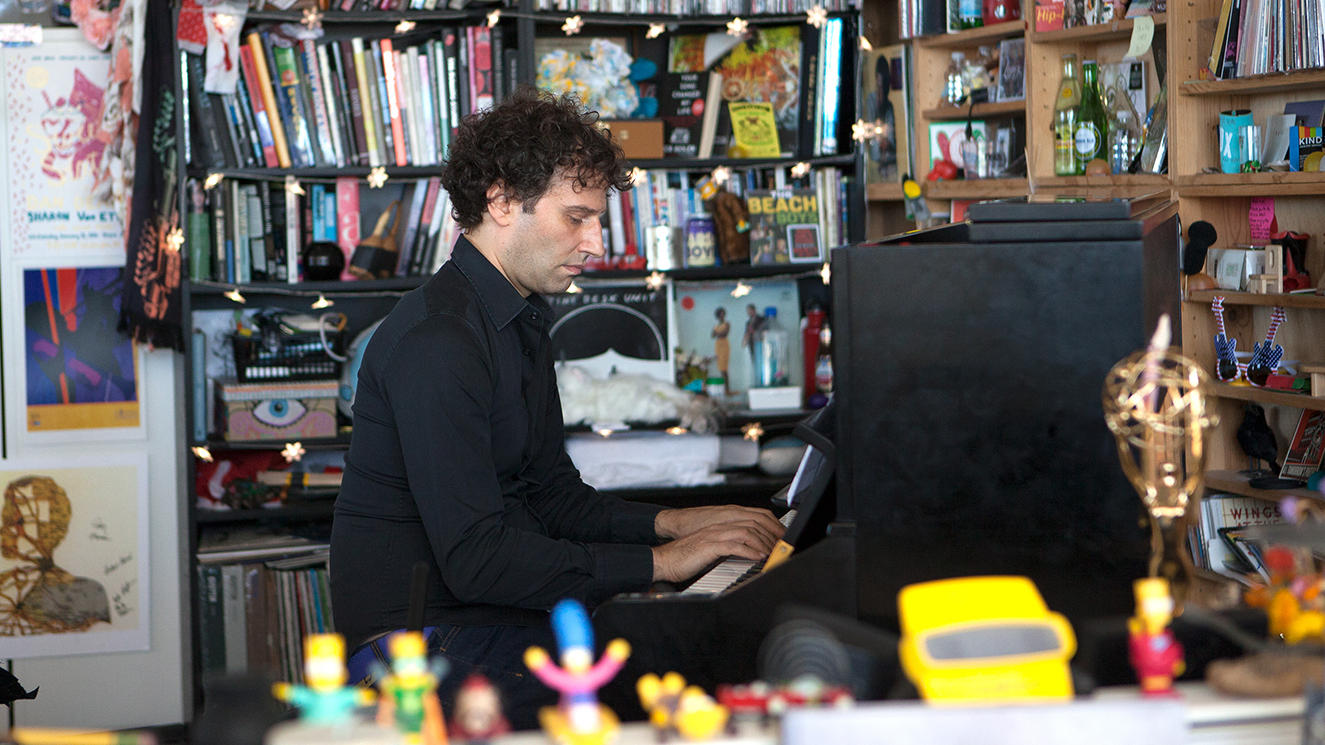
SOUNDTRACK: DAVID GREILSAMMER-Tiny Desk Concert #676 (November 24, 2017).

It has been quite a while since there has been a classical pianist on Tiny Desk.  I’m unfamiliar with the Israeli pianist David Greilsammer, but his playing is wonderful and his selections are quite fun and diverse.

For this Tiny Desk appearance, Greilsammer begins with his muse Domenico Scarlatti, the 18th-century Italian whose 500-some keyboard sonatas are compelling, colorful snapshots of his decades-long service to Spanish royalty. In the “Sonata in E, K. 380” you can hear a little street band processing along with trumpet fanfares.

Greilsammer describes the piece as sounding very contemporary.  Scarlatti lived 300 years ago and his music sounds ahead of its time.  He says it’s almost jazzy or pop-like harmonies.  He says it feels like he is playing a Beatles song.

Greilsammer follows by jumping ahead 175 years to the eccentric Frenchman Erik Satie, who not only owned seven identical gray velvet suits but, with a freewheeling spaciousness and humor in his music, is often thought of as the precursor to everything from minimalism to new age. His series of mysterious pieces called Gnossiennes strike a particularly sedate mood, capable of neutralizing any source of anxiety.

Greilsammer plays “Gnossienne No. 3” which he describes as full of pop and jazz and colors and harmonies.  He was writing these strange short pieces that at the time people in Paris didn’t understand.  Everybody loves Satie now but just over 100 years ago he was completely misunderstood.

I absolutely love the way the final notes ring out in this room–they are quite haunting

Lastly, Greilsammer takes a left turn to Leoš Janáček, the idiosyncratic Czech composer from the early 20th century, acclaimed for his operas. He set one of them on the moon; another, the dramatically taut and emotionally wrenching Jenůfa, is perhaps the most undervalued opera of a generation. But Janáček also wrote in smaller forms. His piano cycle On An Overgrown Path plays out like a diary of musings, nervous tics, simple pleasures and mysteries. Within the claustrophobic tension that pervades “The Barn Owl Has Not Flown Away,” you can hear the rustling of wings and the repeated four-note bird call.

Greilsammer says that Janáček lived in the Romantic period and all of his music is enigmatic, with many secretive things.  He wrote things related to dreams and wild scenes with things obsessively haunting him.  In “The Barn Owl Has Not Flown Away” (from On An Overgrown Path) the theme of the owl comes back many times.  Every time you try to get away from it, it comes back.

For Greilsammer, who recently performed in a working crypt in Harlem, threading these disparate musical fabrics together comes as naturally as, well, playing behind a desk in an office building.

These are some really beautiful and nicely unexpected pieces.

[READ: May 31, 2017] Audubon

I have really enjoyed most of the French graphic novels that come across my desk.  This book, translated by Etienne Gilfillan, is no exception.

It is a biographical sketch of John James Audubon (born Jean-Jacques Audubon in Haiti in 1785).  His story, aside from the whole birding aspect, is quite fascinating in itself. He was an illegitimate child (his father has seduced a servant) who was eventuality adopted by his father (!) and called Forgèére (which means fern).  His father wanted him to escape military conscription, so the boy was sent to Mill Grove in he United States in 1803.  He became a US citizen and there met his wife Lucy Bakewell.

The book actually begins in 1820 with Audubon and two other men sailing on the Mississippi river.  They hit bad weather but all he cares about are his drawings.

Then we jump back to 1812 in Kentucky.  Audubon climbs into a tree to study the swallows who are living in it–some 9,000. He took home more than 100 birds to study them.  And then he tagged some others to study their migratory patterns.

As the end of the book points out, Audubon was one of the world’s greatest naturalists who did a lot for birding. Except he was also responsible for the death of thousands of birds.  There’s a section where he kills two ivory billed woodpeckers.  He is so excited at his luck because they are becoming a rarity. (more…)

Read Full Post »